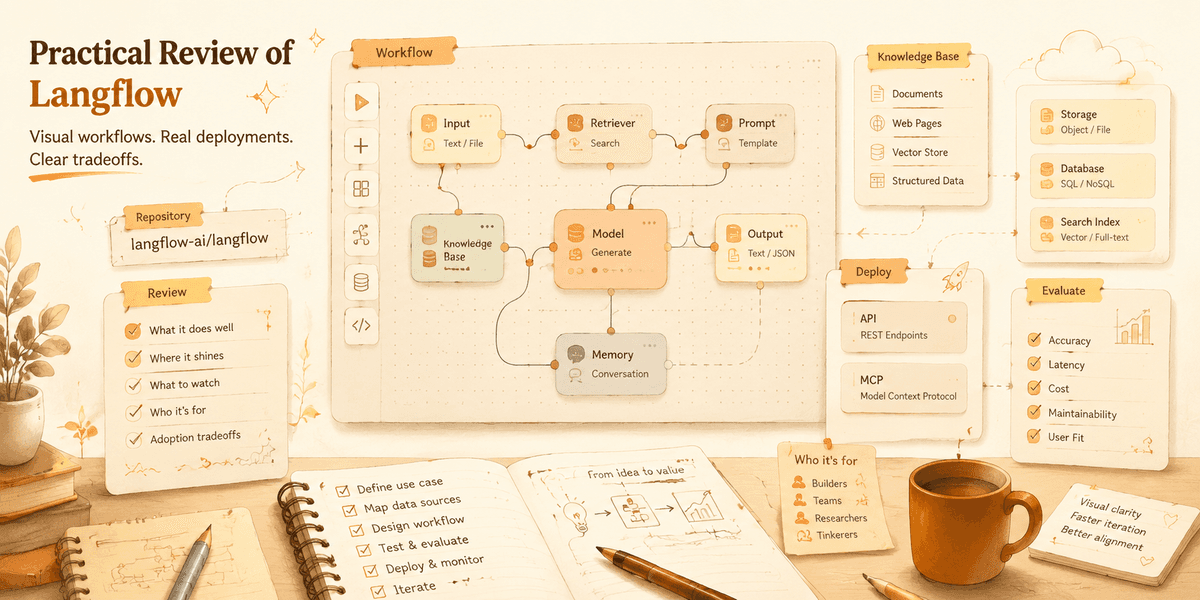
Langflow: Visual Agent Builders Are Useful, But Not Automatic
A practical review of Langflow, its visual workflow model, API and MCP deployment path, and where visual AI builders help or mislead teams.
Visual builders are attractive because they make AI systems feel tangible. A model node connects to a prompt node, a tool node, a retriever, and an output. The workflow is no longer hidden in code. That visibility can help teams think more clearly, but it can also create a false sense of simplicity.
Langflow sits directly in that space. It provides a visual builder for AI-powered agents and workflows, while still allowing Python customization, playground testing, API deployment, and MCP server deployment. TikHub captured Langflow in a July 2026 YouTube video with 33,282 views about open-source AI repositories for self-hosted agent stacks. The video grouped it with Dify, CrewAI, AutoGen, RAGFlow, and other orchestration tools.
When checked on August 13, 2026, Langflow had about 153,175 GitHub stars, 9,855 forks, recent commits, Python as its main language, and an MIT license. Its README emphasizes visual authoring, source-code access, multi-agent orchestration, retrieval, API deployment, MCP server deployment, and observability integrations.
The Real Problem It Solves
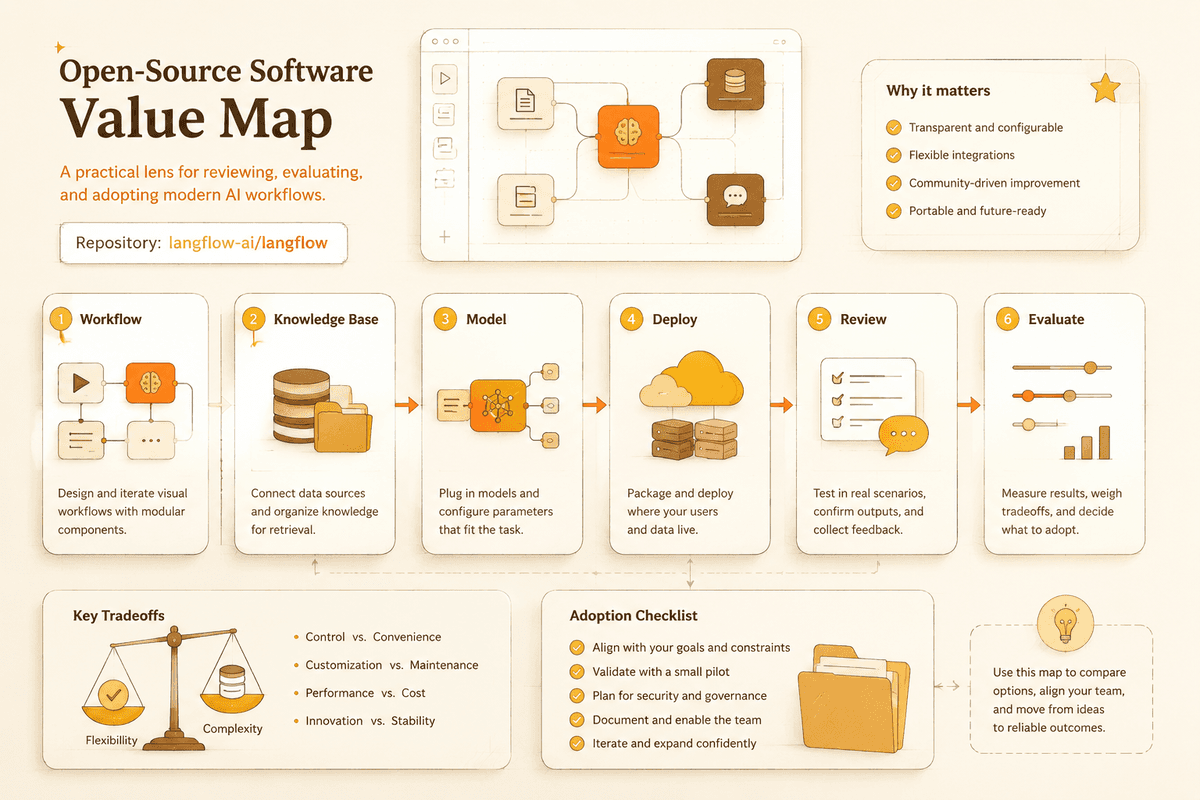
AI workflows can become hard to reason about quickly. A prompt calls a tool. A tool returns data. Retrieval adds context. A model response decides the next step. Another tool writes the result somewhere. In code, that chain can be difficult for non-authors to review.
Langflow makes the chain visible. That is useful for prototyping, teaching, and cross-functional review. A product manager can see which steps exist. A developer can inspect where Python customization is needed. A team can discuss the workflow before it becomes hidden inside an application.
The value is not that visual nodes remove engineering. The value is that they make system shape easier to inspect.
Why It Went Social
Langflow has a natural social format: screenshots of node graphs. Those images communicate "I built an AI workflow" faster than a repository of backend code.
It also fits a real adoption pattern. Many teams are not ready to hard-code every agent workflow. They want to explore combinations of models, prompts, tools, and retrieval before deciding which pieces deserve production code.
The risk is that visual success can look more complete than it is. A flow that works on one example may fail on edge cases, bad inputs, slow APIs, missing permissions, or confusing user intent.
Deployment Difficulty
Git-Stars score: Medium
Langflow is approachable for experimentation. Installing a visual builder and connecting a model is easier than building a full AI app framework. The difficulty rises when the workflow becomes part of a real product.
Teams need to decide how flows are versioned, tested, deployed, observed, and secured. If a flow becomes an API or MCP server, it is no longer just a canvas. It is an integration surface.
For non-coders, Langflow is one of the friendlier AI builder tools to understand visually. But non-coders should still ask a developer to review credentials, external tool calls, and deployment before using a flow with real data.
Commercial Usability
Git-Stars score: High
Langflow reports an MIT license, which is permissive and business friendly. That makes license review simpler than with projects using custom restrictions.
Commercial readiness depends on operations. A visual flow can call APIs, store secrets, retrieve documents, and expose endpoints. Those actions need the same security review as code.
Langflow is strongest commercially when used as a prototyping and controlled workflow layer. It lets teams iterate quickly while still leaving room to extract stable flows into code later.
Capability Ceiling
Git-Stars score: High for prototyping, Medium for complex production systems
Langflow's ceiling is high when the task benefits from visible composition: agent demos, internal automations, RAG experiments, educational workflows, and tool selection.
The ceiling is lower when behavior must be heavily optimized, deeply tested, or tightly integrated with a custom product. Visual tools can become difficult to manage when flows grow too large or when many small business rules accumulate.
The best teams will use Langflow to discover the right workflow, then decide whether to keep it visual, deploy it as an API/MCP tool, or rewrite the stable parts in application code.
Alternatives and Comparisons
Dify is more product-workspace oriented. It is strong when teams want an AI app platform with knowledge bases and app surfaces.
CrewAI focuses on role-based agent orchestration in code. It may fit developers who prefer Python and explicit agent definitions.
AutoGen is a broader agentic programming framework, but its licensing and project maturity should be reviewed carefully for each use.
n8n is stronger for general workflow automation. Langflow is more focused on AI-native flow composition.
Git-Stars Verdict
Langflow is useful because it makes AI workflow structure visible. That helps teams prototype, teach, review, and compare agent designs before committing to custom code.
The important caveat is that visual does not mean safe, complete, or production ready. Treat every flow as software: test it, review permissions, monitor outputs, and decide who owns changes. Used that way, Langflow can be a serious part of an AI builder stack rather than just a pretty canvas.
More Insights
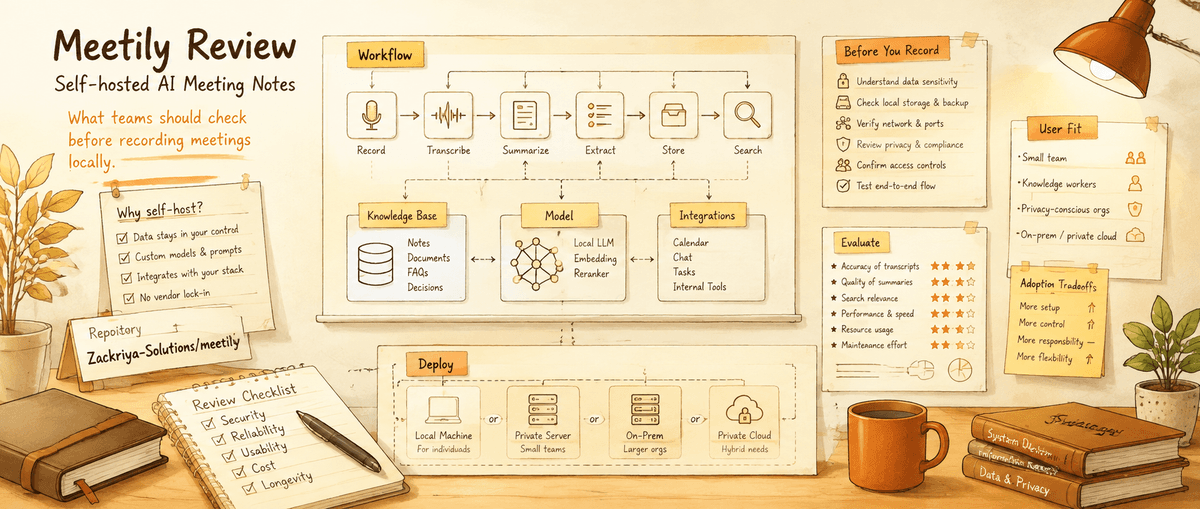
Meetily: Local AI Meeting Notes and the Privacy Trade-Off
A practical review of Meetily, the self-hosted AI meeting note taker, and what teams should check before recording meetings locally.
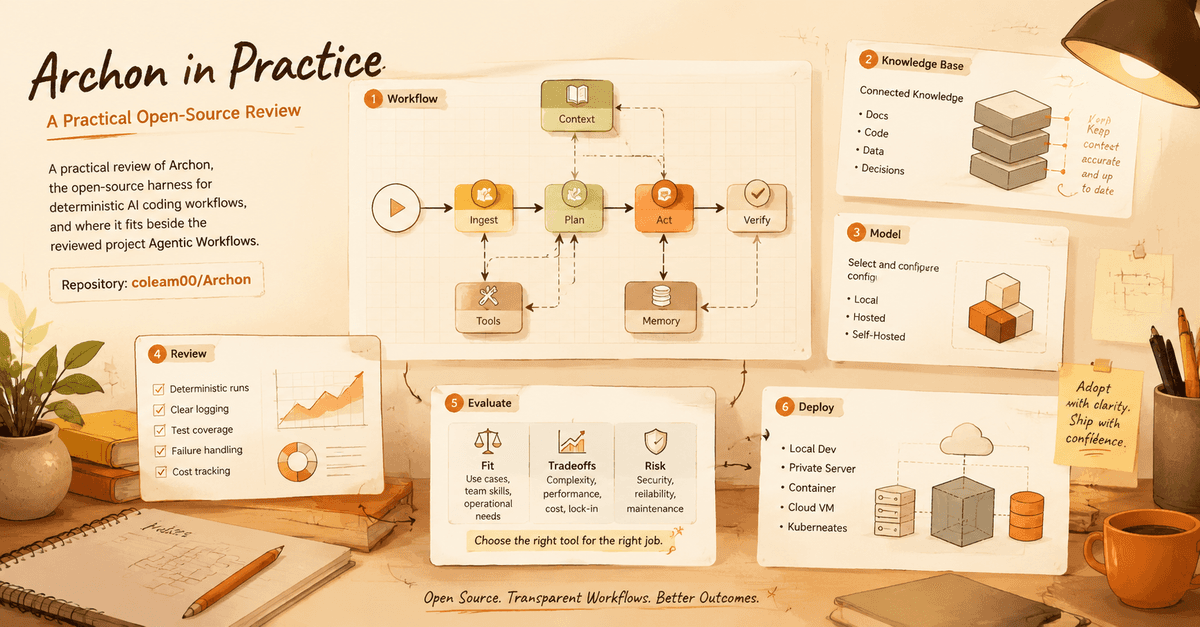
Archon: Can Agentic Coding Workflows Become Repeatable?
A practical review of Archon, the open-source harness for deterministic AI coding workflows, and where it fits beside GitHub Agentic Workflows.
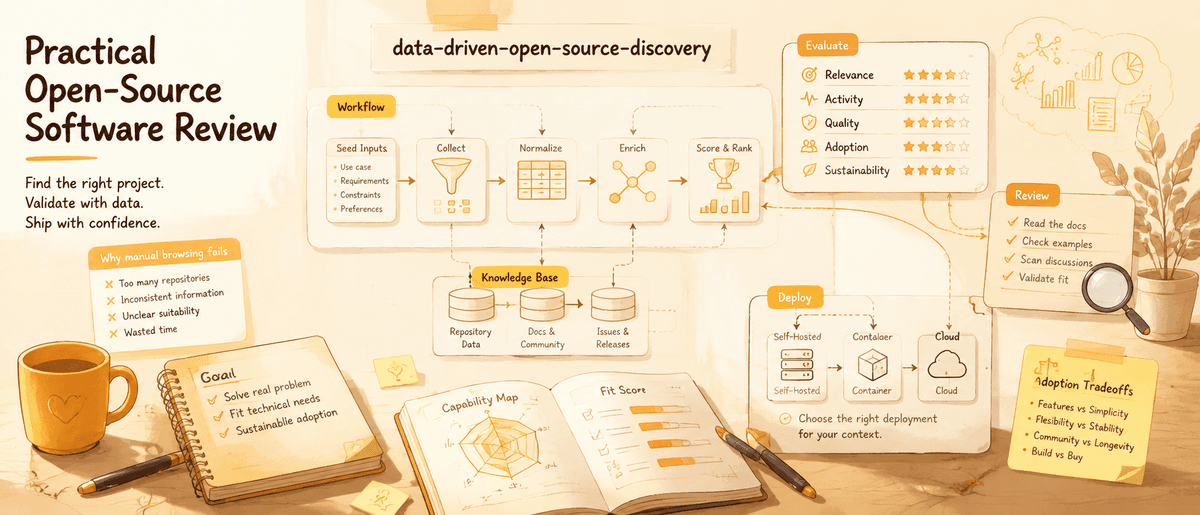
Building a Data-Driven Approach to Open-Source Discovery
Why browsing GitHub manually fails at scale, how data-driven discovery works, and what metrics matter most when finding projects that match your needs.
Newsletter
Join the community
Subscribe to our newsletter for the latest news and updates