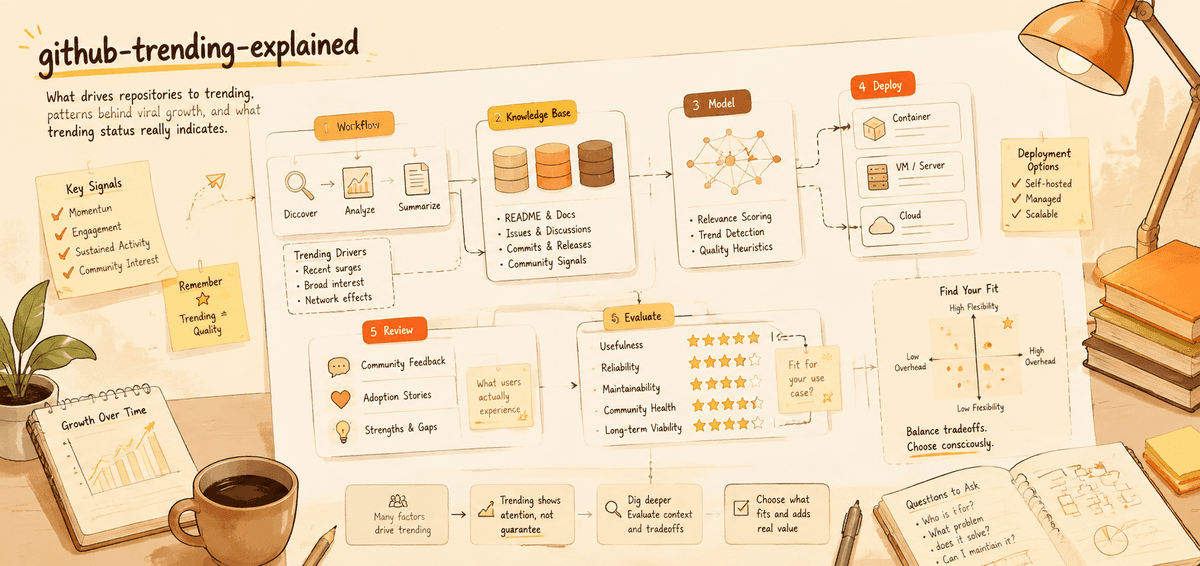
GitHub Trending Explained: How Repositories Go Viral
An analysis of what drives repositories to GitHub's trending page, the patterns behind viral growth, and what trending status actually indicates about project quality.
Every developer has browsed GitHub Trending at least once. The page surfaces repositories that are gaining stars rapidly over a short window—daily, weekly, or monthly. But few people understand exactly how the algorithm works, what gaming looks like, or whether trending status is actually a meaningful signal.
Git-Stars records GitHub Trending snapshots as part of its repository refresh workflow. Here is how we interpret the mechanics, the patterns, and the implications for developers evaluating projects.
How GitHub Trending Actually Works
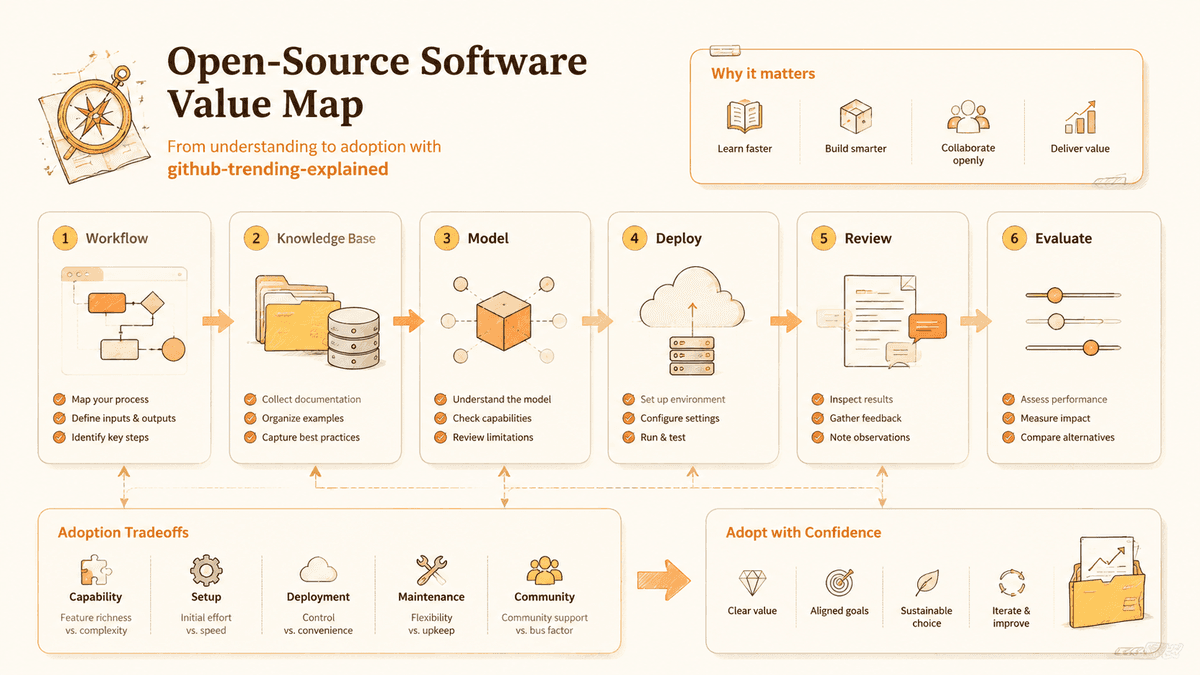
GitHub does not publish the exact algorithm, but through observation we can describe its behavior with reasonable confidence. The trending page ranks repositories by the velocity of new stars within a time window. A repository that gains 200 stars in a day will outrank one that gained 150, regardless of their total star counts.
The algorithm applies some normalization to prevent manipulation. Sudden bursts from suspicious accounts—newly created profiles starring dozens of repos in sequence—appear to be discounted. Geographic diversity of stargazers also seems to matter, though GitHub has never confirmed this.
Language filters segment the results. A Go project only competes against other Go projects when users filter by language. The "all languages" view pits every repository against every other, which tends to favor projects with broader appeal—developer tools, learning resources, and AI/ML frameworks.
The Anatomy of a Viral Repository
Across repeated trending snapshots, we have identified recurring patterns in repositories that achieve rapid growth:
The README-first impression. Trending repositories almost always have polished README files with clear value propositions, GIFs or screenshots demonstrating functionality, and quick-start instructions. The README is the landing page—most visitors decide within seconds whether to star or leave.
Timing and context. Repositories that solve a problem currently in public discourse trend faster. When a major framework announces a breaking change, alternatives trend. When a security vulnerability makes news, patching tools trend. Riding a wave of attention is not gaming—it is relevance.
Social amplification. A single tweet or Hacker News post from a respected figure can trigger a trending cascade. The initial burst of stars from social traffic pushes the repo onto the trending page, which then generates its own organic traffic. This flywheel effect means the first 24 hours are disproportionately important.
Novelty factor. Repositories that present a genuinely new approach—not just another to-do app or component library—trend more easily. The "wow factor" drives sharing.
Trending Triggers: What We Observed in 2025?026
| Trigger Type | Example | Star Velocity | Sustains After Trend? |
|---|---|---|---|
| HN / Reddit front page | Single post by known figure | 500?,000/day | Sometimes |
| YouTube video (tech creator) | Demo or tutorial | 200?,000/day | Often |
| Conference launch | Product announcement | 1,000?,000/day | Usually |
| Controversy / drama | License change, fork | 2,000?0,000/day | Rarely (spikes then fades) |
| Organic discovery | Growing word-of-mouth | 50?00/day | Usually (slow and steady) |
| Bot manipulation | Purchased stars | 500?,000/day | Never (often reverted) |
The most durable trending events are conference launches and organic growth ?they tend to correlate with actual project momentum. Controversy-driven spikes (like license changes that spawn forks) generate massive attention but rarely convert into sustained community engagement.
For a deeper look at how to interpret star signals beyond trending, see our analysis of what GitHub stars actually measure.
What Trending Does Not Tell You
Trending status is a popularity signal, not a quality signal. We have observed repositories reach the number-one spot with zero tests, no license, and code that does not compile on half the platforms it claims to support. The crowd rewards novelty and presentation, not robustness.
Some specific limitations to keep in mind:
Short-term momentum is not sustainability. Many repositories trend once and never see meaningful activity again. The developer got their moment of attention and moved on. This is not inherently bad, but it means you should check what happened after the trending event—did the maintainer continue iterating, or did the project stagnate?
Star count inflation. A repository that trended for a week might have 5,000 stars but only 50 real users. Stars are cheap—they cost one click and create no obligation. Clones, forks with actual modifications, and dependent packages are stronger signals of real usage.
Gaming exists. Star-buying services sell packages of hundreds or thousands of stars from bot accounts. While GitHub actively combats this, detection is imperfect. Sudden star jumps with no corresponding social media activity or package download increases are suspicious.
Patterns We Track at Git-Stars
Our platform goes beyond the snapshot that GitHub Trending provides. We track trending history over time—which projects trend repeatedly versus once, how star velocity correlates with actual adoption metrics, and which trending events lead to sustained community growth.
We also compare trending status against maintenance signals. A repository that trends while also showing healthy commit activity, issue response times, and contributor growth is a qualitatively different signal from one that trends on hype alone.
Using Trending Data Wisely
GitHub Trending is best understood as a discovery channel, not a recommendation engine. Use it to find projects you were not aware of, then apply deeper evaluation before depending on them.
When you see a trending repository in your domain, ask: Does this solve a real problem I have? Is the approach sound, or is it a clever hack? Is there evidence of sustained development, or is this a one-off experiment? Would I trust this code in production six months from now?
The answers to those questions matter far more than the star count on the day you discovered it.
More Insights

Why Voice and Audio AI Projects Are Becoming Viral
A practical look at why open-source voice, speech, and audio AI repositories attract attention and how users should evaluate them.

Alibaba Open Code Review: Where AI Review Helps and Where It Should Slow Down
A practical evaluation of Alibaba Open Code Review, its hybrid rules plus LLM approach, and the real limits of AI-assisted code review.

Browser Use: Web Automation Agents Need Permission and Patience
A practical review of Browser Use, the open-source browser automation layer for AI agents, with deployment, commercial, and safety considerations.
Newsletter
Join the community
Subscribe to our newsletter for the latest news and updates