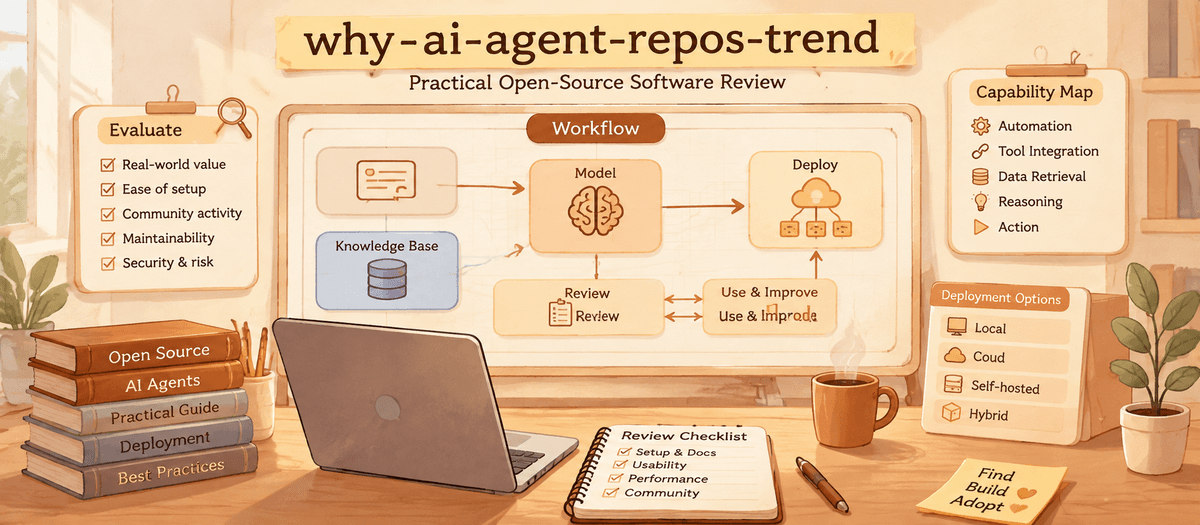
Why AI Agent Repositories Keep Trending on GitHub
An editorial analysis of why AI agent projects spread quickly, which signals matter, and how to separate useful tools from hype.
AI agent repositories keep appearing in GitHub discovery feeds because they promise something unusually concrete: software that can do work. Not only answer questions, but edit files, browse pages, call tools, run commands, generate tests, open pull requests, and coordinate multi-step workflows. That promise is powerful enough to make developers star a project before they have fully tested it.
The category is real, but the attention around it is uneven. Some repositories represent meaningful progress in developer automation. Others are thin wrappers around model calls with ambitious names. The challenge for users is not finding AI agent projects. The challenge is understanding which ones are useful. Our AI Agents page is designed for that second step: comparing projects after the trend has caught your attention.
The Demo Is Easy to Understand
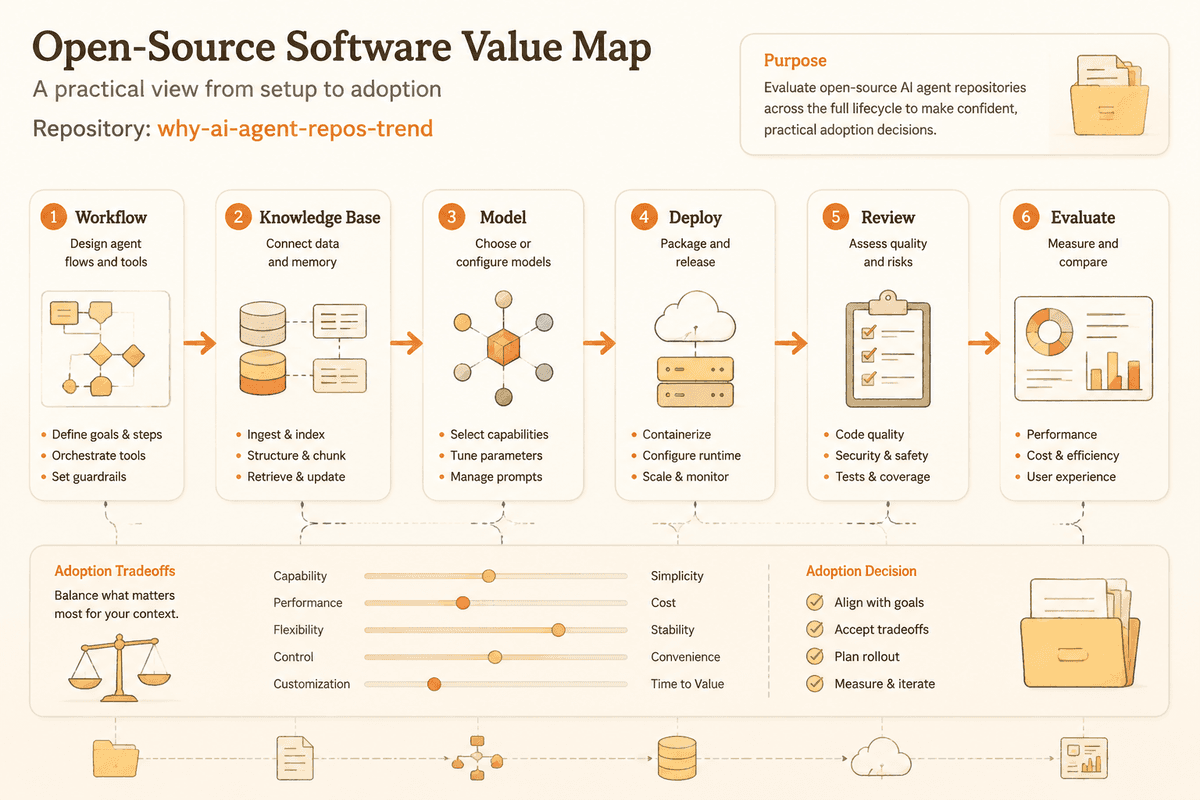
Many open-source categories are difficult to explain quickly. Databases, observability systems, compilers, and infrastructure tools often need context before users appreciate them. AI agents are different. A short demo can show an agent receiving a task, editing code, running tests, and reporting the result. The value proposition is visible.
That makes projects such as OpenHands, AutoGPT, CrewAI, and Microsoft AutoGen highly shareable. Even when their architectures differ, they all connect to a familiar dream: delegate work to software.
Shareability matters on GitHub because trending behavior often starts outside GitHub. A demo video, launch post, benchmark result, or public experiment can send users to a repository in a short window. The trending page then amplifies that attention.
Developers Feel the Pain Directly
AI agent projects target work developers already dislike or struggle to scale: boilerplate changes, test writing, migration chores, documentation updates, debugging, dependency upgrades, code review, and repetitive integration tasks.
The pain is not abstract. Every developer has a backlog of small tasks that are important but tedious. An agent that can safely complete even a fraction of those tasks is interesting.
This is why coding agents often attract attention faster than general chatbot projects. They connect model capability to an existing workflow. The repository is not just "AI for conversation"; it is "AI for my pull request, my issue, my test suite, my local files."
The Category Has Many Entry Points
"AI agent" is a broad label. Some projects are end-user tools. Some are frameworks. Some are research environments. Some are workflow orchestrators. This variety keeps the category active because different users enter from different needs.
OpenHands appeals to users interested in autonomous software engineering. CrewAI appeals to people modeling role-based multi-agent workflows. AutoGen attracts users exploring conversation patterns between agents. LangGraph fits teams that want graph-based control over LLM workflows.
These are not interchangeable projects. Treating them as one category can be misleading. But the shared vocabulary helps them spread: agents, tools, planning, memory, orchestration, evaluation, autonomy.
The Numbers Behind the Trend
The scale of AI agent activity on GitHub is no longer anecdotal. According to multiple community trackers and analysis posts published in 2025?026:
GitHub now hosts over 4.3 million AI-related repositories ?a 178% year-over- year jump in LLM-focused projects. The AI agent subcategory grew even faster. AutoGPT alone spawned hundreds of forks and derivatives after its 2023 launch, and the pattern repeated with each new wave: CrewAI, OpenHands, LangGraph, and most recently Hermes Agent (140K+ stars in under three months).
Community observations from developer forums and comparison articles:
- The r/LocalLLaMA and r/MachineLearning subreddits now have weekly "agent recommendation" threads
- Developers report "agent fatigue" ?too many projects with similar names and overlapping claims
- The most trusted signals are now SWE-bench scores, real PR examples, and cost-per-task data rather than star counts
- Teams increasingly distinguish between "agent frameworks" (build your own) and "agent products" (use as-is)
Current Agent Landscape (August 2026)
| Project | Primary Use | Stars | Model Approach | Best For |
|---|---|---|---|---|
| OpenHands | Autonomous SWE | ~180K | Multi-model | Full issue-to-PR automation |
| AutoGPT | General autonomous | ~170K | GPT-4 / local | Broad task delegation |
| CrewAI | Multi-agent roles | ~65K | Any LLM | Team-simulation workflows |
| Microsoft AutoGen | Conversation agents | ~45K | Azure / OpenAI | Research, multi-turn |
| LangGraph | Graph workflows | ~30K | Any LLM | Custom agent control flow |
| Hermes Agent | Self-improving personal | ~230K | Multi-backend | Long-running personal assistant |
| Archon | Deterministic coding | ~23K | Per-step choice | Repeatable issue-to-PR DAGs |
Hype and Real Utility Coexist
The AI agent category has genuine utility, but it also has unusually high hype risk. A project can look impressive in a narrow demo and fail on messy real tasks. Agents are sensitive to context quality, model choice, tool reliability, cost, permissions, and evaluation design.
Useful agent projects tend to show:
- Clear task boundaries
- Tool-use logs
- Evaluation examples
- Safety controls
- Human review points
- Model provider flexibility
- Failure-mode documentation
Risky projects tend to show:
- Grand claims without tests
- Cherry-picked demos
- No cost visibility
- No sandboxing story
- No explanation of what happens when the agent is wrong
This is why Git-Stars treats agent repositories as decision objects, not just trend objects. A trending agent may be worth watching without being ready to adopt.
Evaluation Is Becoming the Differentiator
As the category matures, the best projects will not be the ones with the boldest claims. They will be the ones that can show how they are evaluated. Benchmarks such as SWE-bench helped the community discuss coding-agent performance more concretely, but no benchmark covers every real workflow.
For users, the important question is: does this project test the kind of task I need it to perform? An agent that performs well on isolated coding tasks may struggle with product judgment, ambiguous requirements, legacy systems, or multi-repository changes.
Good projects expose their limits. They explain which tasks are suitable, which require review, and which should remain human-owned.
Non-Coders Are Part of the Audience Too
AI agent repositories are not only for developers. Founders, creators, analysts, and operators increasingly want to use open-source tools but lack the technical confidence to install or modify them. Agents can act as translators between a repository and a non-coder's goal.
That does not mean non-coders should run every agent project. Many require local development environments, API keys, repository permissions, or command-line comfort. But the category is expanding the audience for GitHub itself. A person who would never read source code may still use Codex or Claude to understand whether a repository is worth trying.
This is one reason agent projects spread beyond traditional developer circles. They promise access, not only automation.
How to Read an AI Agent Repo
When an AI agent repository trends, evaluate it with five questions:
What work does it actually perform? Ignore broad labels and identify the task type.
How does it use tools? File edits, browser actions, shell commands, and API calls have different risks.
Where is human review required? Fully autonomous claims deserve scrutiny.
How is success measured? Look for evaluations, examples, and failure cases.
What does it cost to run? Token usage, model choice, retries, and context size can change the economics.
If a repository cannot answer these questions, it may still be interesting, but it should be treated as experimental.
Why the Trend Will Continue
AI agent repositories will continue trending because the underlying user need is strong. Developers want leverage. Teams want automation. Non-coders want access to technical tools. Model capabilities keep improving, and open-source projects turn those capabilities into visible workflows.
The category will also become more disciplined. Users will demand clearer evaluation, safer execution, better observability, and more honest limitations. The projects that survive will be those that move from impressive demos to repeatable results.
For now, the right stance is curiosity with discipline. Watch the trend, test carefully, and do not confuse a viral repository with a dependable workflow.
Author
Categories
More Insights
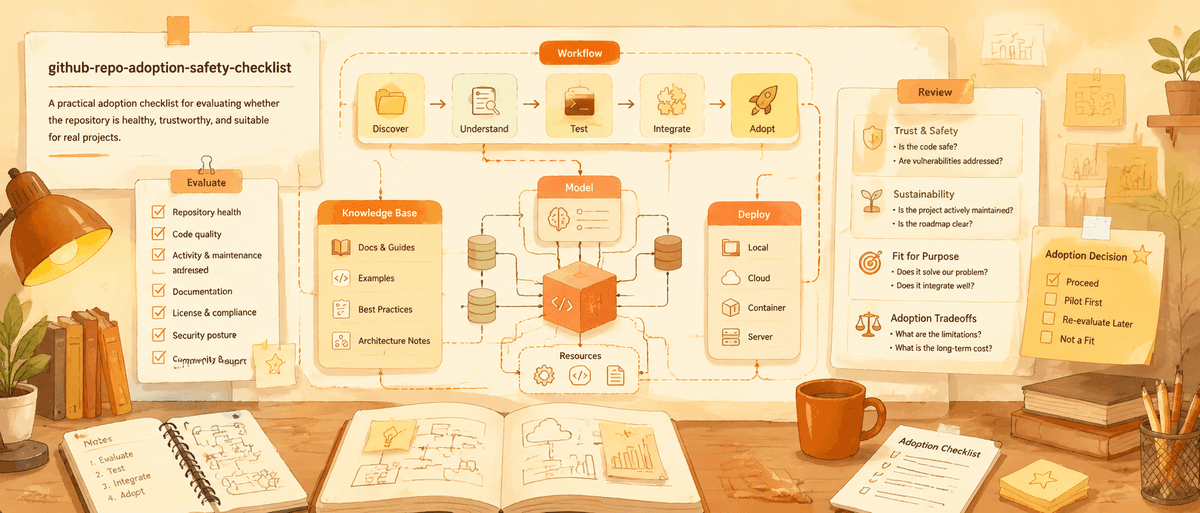
How to Judge If a GitHub Repo Is Safe to Adopt
A practical adoption checklist for evaluating whether a GitHub repository is healthy, trustworthy, and suitable for real projects.
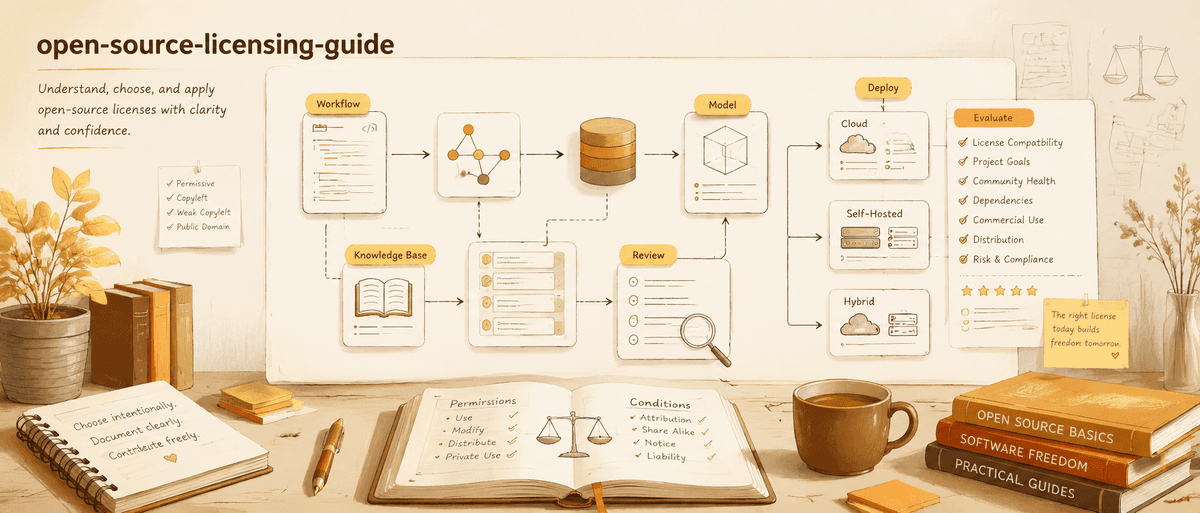
Open-Source Licensing in 2026: A Practical Guide for Developers
Navigate the evolving landscape of open-source licenses, understand what each permits and restricts, and make informed choices for your projects and dependencies.
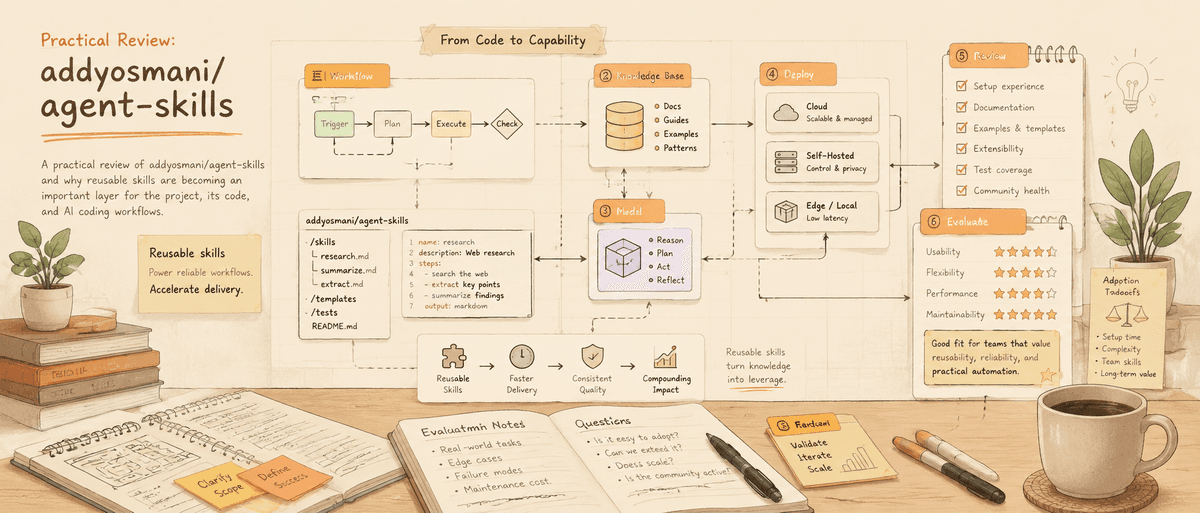
Agent Skills: Why AI Coding Agents Need Reusable Working Memory
A practical review of addyosmani/agent-skills and why reusable skills are becoming an important layer for Codex, Claude Code, and AI coding workflows.
Newsletter
Join the community
Subscribe to our newsletter for the latest news and updates