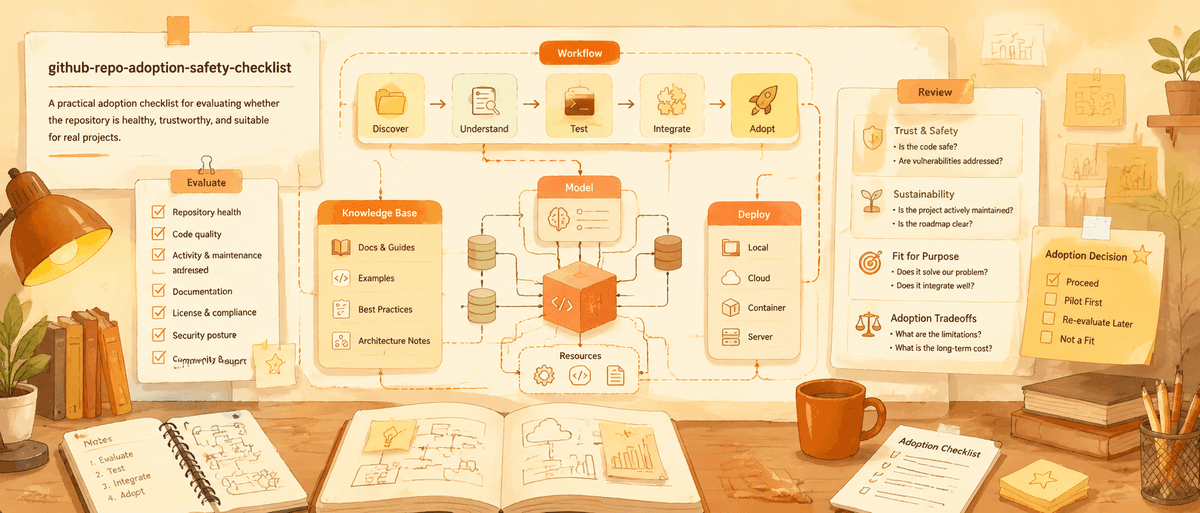
How to Judge If a GitHub Repo Is Safe to Adopt
A practical adoption checklist for evaluating whether a GitHub repository is healthy, trustworthy, and suitable for real projects.
Choosing an open-source project is rarely a single technical decision. It is a maintenance decision, a security decision, a licensing decision, and sometimes a business continuity decision. A repository can look impressive on GitHub and still be a poor dependency for your team. The README may be polished, the demo may be exciting, and the star count may be large, but none of those signals proves that the project is safe to adopt.
Git-Stars evaluates repositories as decision objects rather than popularity objects. The question is not "is this project famous?" The better question is: if a small team depended on this project for the next twelve months, what could go wrong, and which signals reduce that risk?
This checklist is meant for developers, product builders, technical founders, and non-coders using tools like Codex or Claude to evaluate a repository before installing it. It does not replace a legal review or a security audit, but it does help you avoid the most common adoption mistakes.
Start with the Problem Fit
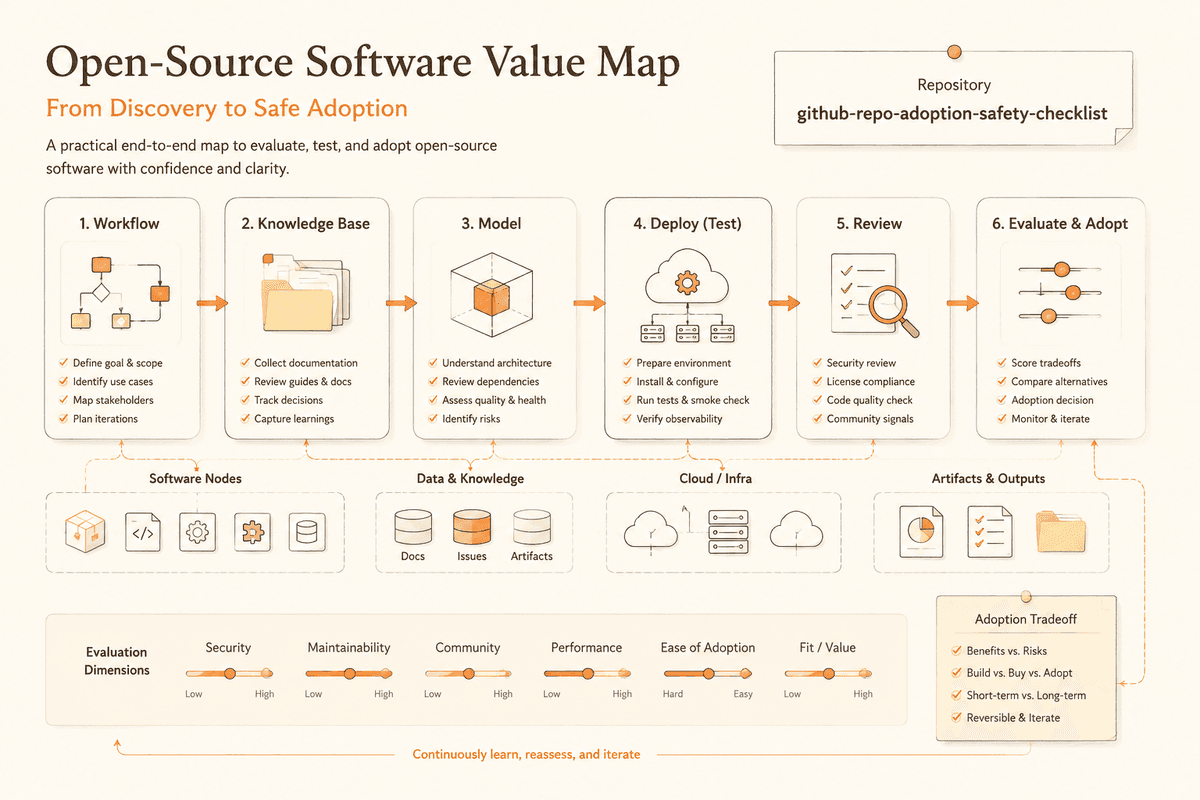
Before reading the installation instructions, ask what problem the repository actually solves. A repo that is excellent for experimentation may be unsuitable for production. A tool that is powerful for developers may be frustrating for non-coders. A framework that shines in one ecosystem may add needless complexity in another.
For example, Next.js is a strong choice for full-stack React applications when you want routing, server rendering, API routes, and a large ecosystem in one place. It is not automatically the right choice for a small static documentation site. FastAPI is excellent for Python APIs with type hints and interactive docs, but if your team does not use Python, the operational cost may outweigh the elegance. LangChain can be useful for building LLM workflows, but teams that only need a few direct model calls may find the abstraction heavier than necessary.
The first safety question is therefore simple: does the repository solve your real problem, or does it solve an adjacent problem that only looks similar?
Check Maintenance Before Features
Many teams evaluate features first and maintenance second. That is backwards. Features are valuable only if the project remains healthy enough to support them. A stale project can become expensive even when the code still works.
Look for recent commits, releases, issue triage, pull request reviews, and maintainer responses. A project does not need daily commits to be healthy. Stable infrastructure libraries may move slowly by design. But you should be able to see evidence that maintainers still pay attention.
Healthy patterns include recent releases, clear changelogs, issue labels, answered bug reports, and merged external contributions. Warning signs include unanswered installation failures, many open security issues, a single maintainer doing all work without a succession plan, or release notes that hide breaking changes.
Git-Stars' Top Stars page is useful for discovery, but the star count should only open the door. The adoption decision should be based on maintenance signals, not the popularity number alone.
Read the License Like a Deployment Requirement
License metadata is not decoration. It tells you what you are allowed to do with the software and what obligations may follow. For internal experiments, teams often skip this step. For commercial use, that shortcut can become expensive.
MIT, Apache 2.0, BSD, and ISC are generally permissive and business-friendly. GPL and AGPL require closer review because distribution or network use may trigger source-sharing obligations. Source-available licenses such as BSL, SSPL, or Elastic License 2.0 may allow reading and modifying code while restricting managed service or competitive use cases.
The practical rule is this: if the repository has no license, treat it as "not cleared for reuse" until clarified. Public code without a license is visible, but visibility is not permission. If the license changed recently, check the version you plan to use and the terms attached to it.
Our commercial use checklist goes deeper on this topic, but the core idea is enough for most early screening: license risk belongs at the beginning of adoption, not at the end.
Inspect the README for Operational Honesty
A good README does not only show happy-path installation. It tells you what the project needs in the real world. Look for runtime requirements, supported platforms, environment variables, model or API costs, database dependencies, GPU requirements, security assumptions, and upgrade notes.
AI projects make this especially important. Ollama has a different deployment profile from a hosted API wrapper. ComfyUI can be powerful but often requires careful model, GPU, and extension management. Dify offers a more application-like experience, but it introduces service orchestration, database, and operational considerations. None of these is "better" in the abstract. They fit different users.
If the README promises one-command setup but the issues are full of deployment failures, believe the issues. If the README shows only a demo GIF and no error recovery path, assume you will need engineering time. If the project requires paid APIs, check whether the cost appears in the docs or only emerges after installation.
Look for Evidence of Real Use
Stars measure attention. They do not prove adoption. Better signals include forks with meaningful changes, package downloads, dependent repositories, case studies, plugin ecosystems, public integrations, and issue discussions from users solving real problems.
This does not mean small projects are unsafe. A focused library with 800 stars, clear tests, careful releases, and active maintainers may be safer than a 50,000-star project that has slowed down. The key is to distinguish attention from use. A project can go viral because it is novel, funny, or well-presented. That is a discovery signal, not a reliability signal.
Our Viral Repos reports are designed around this distinction. They ask why a project is spreading, what problem it solves, how difficult it is to deploy, whether it is commercially usable, and what its capability ceiling looks like.
Check the Issue Tracker for the Kind of Pain You Might Inherit
Open issues are not automatically bad. Popular projects naturally have many issues. What matters is the pattern. Are maintainers asking for reproductions? Are duplicate reports being consolidated? Are serious bugs acknowledged? Are installation problems concentrated around the same missing documentation?
Read recent closed issues as well as open ones. Closed issues show how the project behaves under friction. A repo with many open issues but active triage may be healthier than a repo with fewer issues and no visible maintainer response.
For adoption safety, pay special attention to issues about data loss, security, license confusion, broken upgrades, dependency conflicts, and unsupported platforms. Those problems can cost more than a missing feature.
Decide Who Owns the Risk
The final adoption question is organizational: if this dependency breaks, who will own the fix? If your team has the language expertise, deployment knowledge, and time to patch around problems, you can accept more risk. If non-coders will operate the tool, or if it will sit inside a revenue-critical workflow, you need a more conservative threshold.
Use a simple decision record:
- What problem are we solving?
- Which alternatives did we compare?
- Why did we choose this repo?
- What risks did we accept?
- What would make us switch away?
That record turns a vague preference into a decision your future team can review. It also prevents the common mistake of choosing a dependency because it felt exciting during a demo.
A Practical Adoption Scorecard
For an initial screen, rate each area from 1 to 5:
| Criterion | Score 1 (Red flag) | Score 3 (Acceptable) | Score 5 (Strong) |
|---|---|---|---|
| Problem fit | Solves adjacent problem | Partial match, needs adaptation | Exact match for your use case |
| Maintenance | No activity 6+ months | Sporadic but responsive | Regular releases + active triage |
| License clarity | No license or recently changed | Copyleft (requires review) | Permissive (MIT/Apache/BSD) |
| Deployment difficulty | Undocumented, many open install issues | Documented but complex | One-command or well-paved path |
| Evidence of use | Stars only, no real users visible | Some forks and discussions | Package downloads, dependent repos, case studies |
| Operational risk | Single maintainer, no tests | Small team, basic CI | Org-backed, comprehensive test suite |
Problem fit: Does the project solve your exact use case?
Maintenance: Are releases, commits, and issue responses still healthy?
License clarity: Can you use it in your intended commercial or internal context?
Deployment difficulty: Can your team run it without heroic setup work?
Evidence of use: Are there signs of real adoption beyond stars?
Operational risk: If it fails, can your team diagnose and recover?
You do not need perfect scores. You need an honest picture. A project with weak documentation but strong maintainers may still be adoptable. A project with a beautiful landing page but unclear licensing should wait. A project that is great for developers may still be wrong for non-coders.
The safest open-source choices are rarely the loudest. They are the ones where the fit, maintenance, license, and deployment story all make sense together.
Author
Categories
More Insights
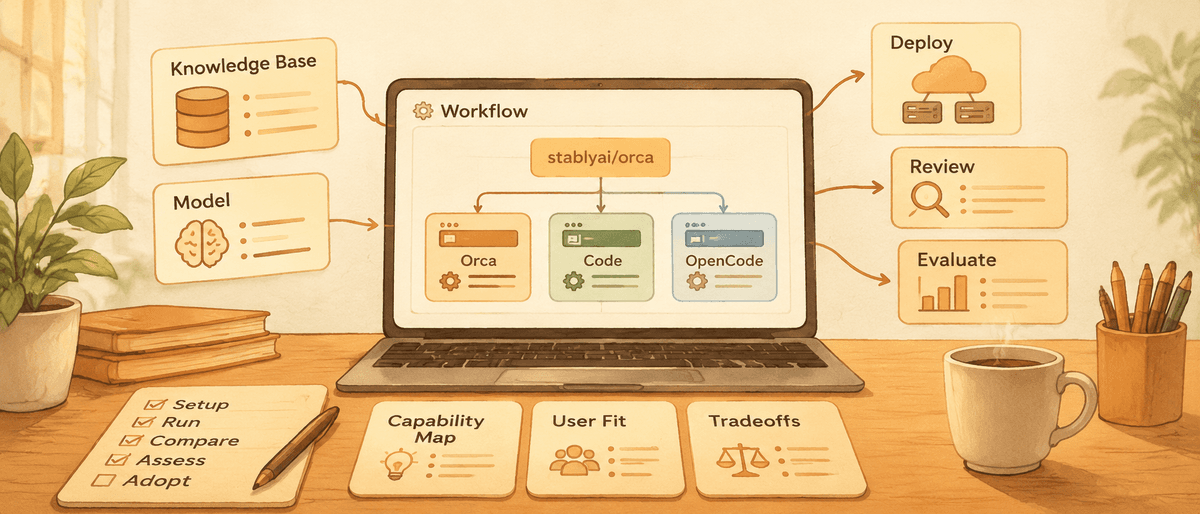
Orca: Do Parallel Coding Agents Need Their Own Workspace?
A practical review of Orca, the agent development environment for running Codex, Claude Code, OpenCode, and other coding agents side by side.
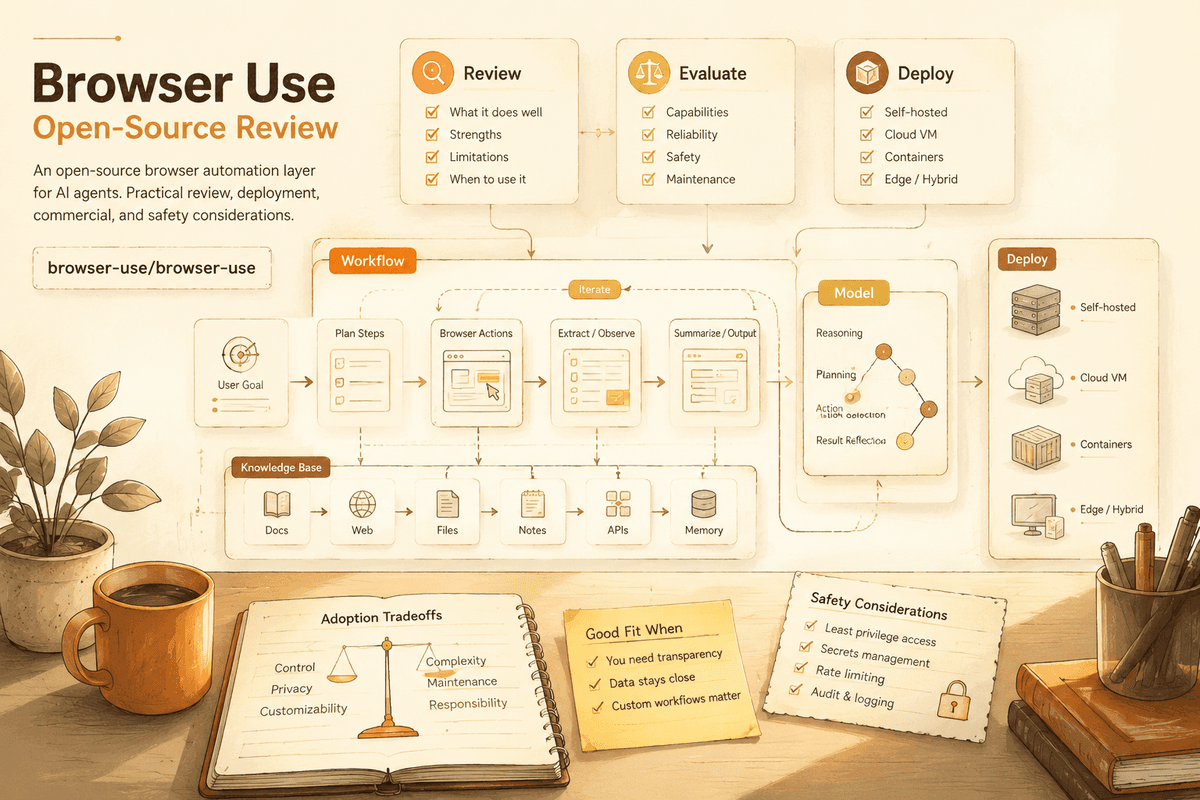
Browser Use: Web Automation Agents Need Permission and Patience
A practical review of Browser Use, the open-source browser automation layer for AI agents, with deployment, commercial, and safety considerations.
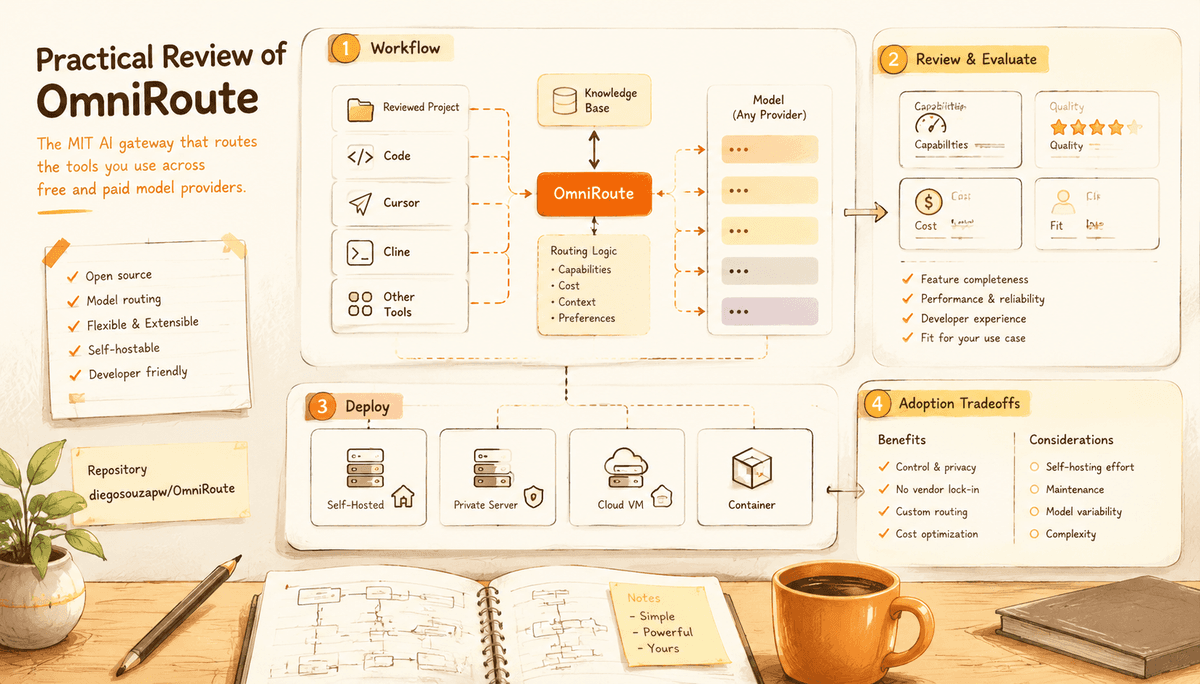
OmniRoute: Can a Free AI Gateway Replace Paid Model Routers?
A practical review of OmniRoute, the MIT AI gateway that routes Codex, Claude Code, Cursor, Cline, and other tools across free and paid model providers.
Newsletter
Join the community
Subscribe to our newsletter for the latest news and updates