
Strix: Where AI Penetration Testing Helps and Where It Needs Guardrails
A practical review of Strix, the open-source AI penetration testing tool, with deployment, commercial, and safety considerations for teams.
Security is one of the most tempting AI automation categories because the work is both valuable and repetitive. Applications need reconnaissance, endpoint mapping, input testing, authentication checks, dependency review, proof validation, and remediation notes. A good assistant could save time. A careless assistant could also create noise or risk.
That is why Strix deserves a careful review rather than a hype reaction. It presents itself as an open-source AI penetration testing tool: autonomous agents that inspect applications, find vulnerabilities, validate them, and help generate fixes or reports.
TikHub captured Strix in a July 31, 2026 YouTube roundup about AI agents, privacy, and security GitHub projects. That source had 6,079 views when collected. Another July 2026 video framed Strix as one of the AI repositories competing with expensive security tooling. We should treat that framing carefully. Security testing is not something to "cancel" without understanding scope, permission, and verification.
When checked on August 13, 2026, the repository had about 51,740 GitHub stars, 5,557 forks, recent commits, Python as its main language, and an Apache-2.0 license. Its topics include AI penetration testing, cybersecurity, ethical hacking, red teaming, security automation, LLM security, and bug bounty.
The Real Problem It Solves
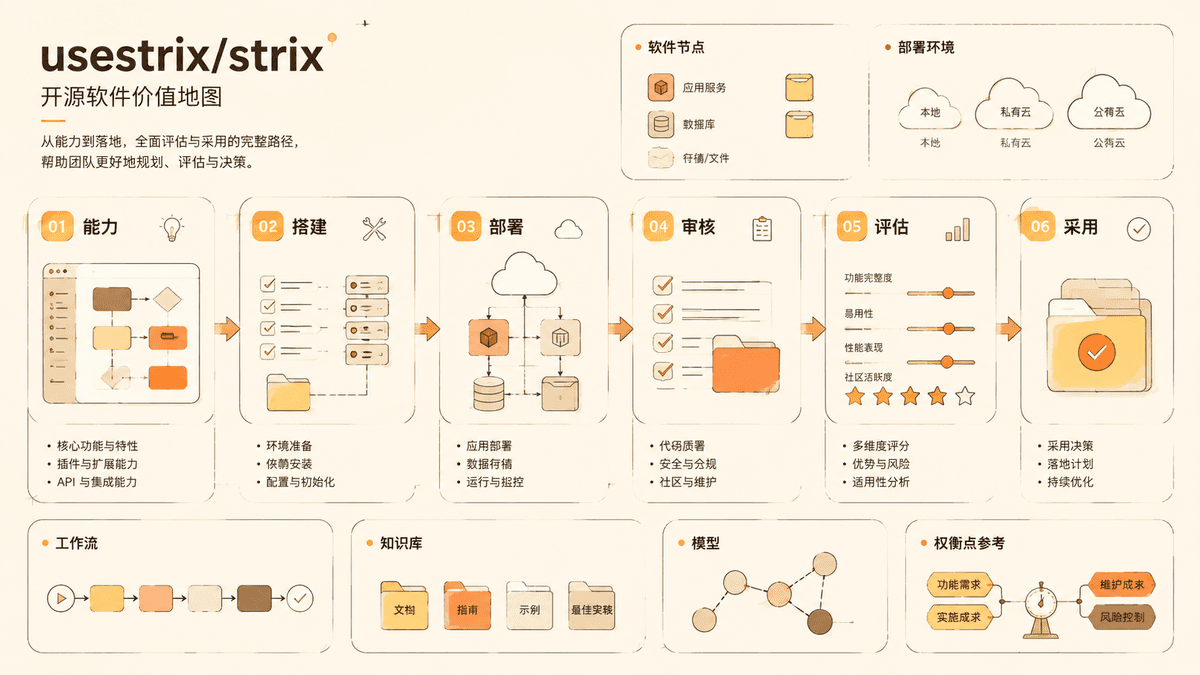
Traditional application security has an uncomfortable gap. Static analysis tools can produce many findings but struggle to prove exploitability. Manual penetration testing is valuable but expensive and periodic. Developers need feedback earlier than an annual audit and more concrete than a vague warning.
Strix tries to sit between those worlds. The interesting claim is not simply "AI finds bugs." The useful claim is that an agent can combine reconnaissance, dynamic testing, validation, and remediation notes into a faster loop.
That loop matters because security findings are only useful when teams can understand and act on them. A long list of possible vulnerabilities creates fatigue. A validated issue with reproduction steps, impact, and a suggested fix is easier to prioritize.
Why It Went Social
The social appeal is obvious: "AI hackers that find and fix vulnerabilities" is an unusually concrete promise. It sounds more useful than another chatbot and more exciting than another lint rule.
It also maps to a real developer frustration. Many small teams cannot afford frequent manual pentests. They still ship web apps, APIs, auth flows, file uploads, and admin dashboards. A tool that can run earlier in CI or against a staging app feels like a practical safety net.
But the same pitch creates risk. A penetration testing agent should never be treated as permission to test systems you do not own. It should also not be treated as a complete security review. AI can help security workflows, but security remains an accountability-heavy domain.
Deployment Difficulty
Git-Stars score: Medium to High
The README points to a developer-first CLI and hosted getting-started paths, but the difficulty depends on what you test. Running a basic scan may be straightforward. Running a meaningful pentest against a real application requires target scoping, credentials, staging environments, rate limits, safe test data, and agreement on what the tool is allowed to do.
For developers, the safest first step is a local demo application or staging target designed for testing. Do not point a new security agent at production until you understand request volume, authentication behavior, data mutation, and reporting output.
For non-coders, Strix is not a casual toy. If you are not comfortable with application ownership and testing permission, do not run it against live services. Ask a developer or security practitioner to supervise the first run.
Commercial Usability
Git-Stars score: High for license, Medium for process
Strix reports an Apache-2.0 license, which is generally business friendly and includes a patent grant. That makes it easier to evaluate for internal security workflows.
Commercial use still needs process controls. Security testing can touch customer data, authentication systems, logs, and infrastructure protections. A company should define approved targets, safe scan windows, rate limits, data handling rules, and escalation paths before making AI pentesting part of CI.
The best commercial pattern is augmentation: Strix can help developers find issues earlier and give security teams more context. It should not replace human review for high-risk releases, compliance requirements, or incidents.
Capability Ceiling
Git-Stars score: High for early testing, Medium for assurance
The ceiling is high because dynamic validation is valuable. If an AI agent can find a path, test a payload, prove impact, and suggest a fix, it can reduce a lot of manual triage time.
The ceiling is limited by false negatives, target complexity, and judgment. Authentication-heavy apps, business-logic flaws, chained vulnerabilities, and environment-specific issues remain hard. A tool may miss a serious issue or overstate a minor one.
The right success metric is not "did it find everything?" A better metric is: did it find useful issues earlier, reduce duplicate manual work, and produce reports developers could act on?
Alternatives and Comparisons
Semgrep is strong for code-level static analysis and policy enforcement. Strix is more focused on agentic dynamic testing and validation.
OWASP ZAP remains an important open-source web application security scanner. It is mature and transparent, though less AI-native.
Burp Suite is still a standard for professional web application testing. Strix is not a direct replacement for an experienced tester using Burp.
Snyk, GitHub Advanced Security, and similar platforms focus on dependency, code, and workflow security. Strix is closer to active application testing.
Who Should Try It
Strix is worth watching for developers and security teams that already have a staging environment, clear test targets, and a desire to shift security feedback earlier in the development process.
It is less appropriate for people looking for a magic security certificate. No AI pentesting tool can promise that an application is safe. The responsible use case is finding more problems sooner, not declaring security complete.
For Git-Stars, Strix belongs in the security automation category. It is interesting because it makes AI agents concrete: they do not only chat about code; they interact with applications and attempt validation. That is powerful, and it is exactly why guardrails matter.
Git-Stars Verdict
Strix is one of the more serious AI security repositories to watch because it targets a real workflow: application testing with validation and remediation context. Its Apache-2.0 license and strong GitHub momentum make it attractive.
The adoption recommendation is cautious: run it only on systems you own or are authorized to test, start with staging, review generated findings manually, and keep human security judgment in the loop. AI can make security testing more continuous. It cannot remove responsibility.
更多洞察

Mem0: Agent Memory Is Useful Only When It Is Governed
A practical review of Mem0, the open-source memory layer for AI agents, and the privacy, deployment, and product questions teams should ask.
Langflow: Visual Agent Builders Are Useful, But Not Automatic
A practical review of Langflow, its visual workflow model, API and MCP deployment path, and where visual AI builders help or mislead teams.

Hallmark and Design Skills: Can Open Source Teach AI Better Taste?
A Git-Stars review of Hallmark, emilkowalski/skills, and why reusable design guidance matters for Codex, Claude Code, and AI-built interfaces.
邮件列表
加入我们的社区
订阅邮件列表,及时获取最新消息和更新