Mem0: Agent Memory Is Useful Only When It Is Governed
A practical review of Mem0, the open-source memory layer for AI agents, and the privacy, deployment, and product questions teams should ask.
AI agents become more useful when they remember. A support assistant should remember a customer's preferences. A coding assistant should remember project conventions. A personal assistant should remember what the user corrected last time. Without memory, every interaction starts from zero.
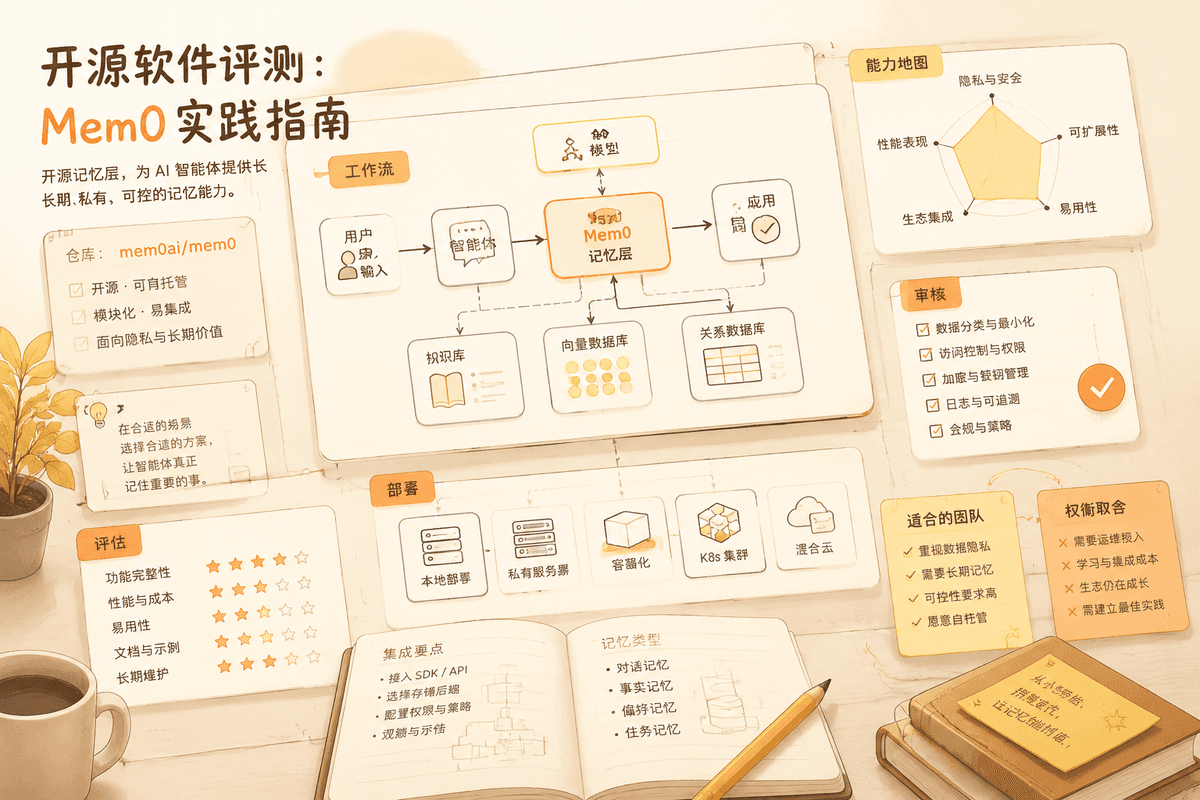
That is the promise behind Mem0, which describes itself as a universal memory layer for AI agents. TikHub captured it in a July 2026 YouTube video with 33,282 views about open-source AI agent stacks. The video framed Mem0 as the "memory" piece in a system that also included browser automation, crawling, orchestration, local inference, and RAG.
When checked on August 13, 2026, Mem0 had about 63,192 GitHub stars, 7,372 forks, recent activity, Python as its main language, and an Apache-2.0 license according to GitHub metadata. Its topics include AI agents, long-term memory, memory management, RAG, state management, and chatbots.
The Real Problem It Solves
Most AI applications are stateless unless developers add memory themselves. That creates repeated questions, repeated instructions, and brittle personalization. Users can feel that an assistant is intelligent in one moment and forgetful in the next.
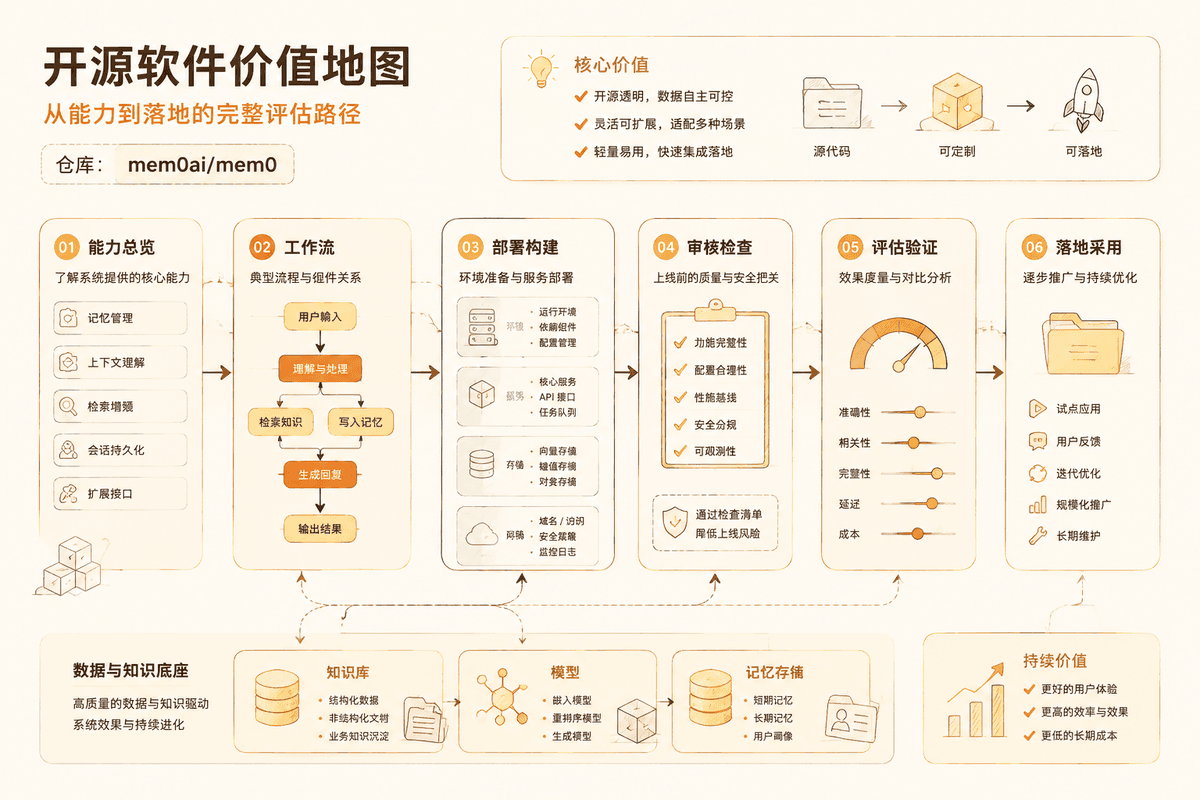
Mem0 tries to separate memory from the application. Instead of every team building its own memory extraction, storage, retrieval, and update logic, the memory layer becomes a reusable component.
The value is not just convenience. A dedicated memory layer can make behavior more inspectable. Teams can ask what was remembered, why it was retrieved, and whether it should be deleted.
Why It Went Social
Memory is easy to explain because everyone has felt the failure. The assistant asks the same thing again. It forgets a preference. It ignores prior corrections. A project that claims to solve that pain has a natural social hook.
The timing also matters. As agents move from one-shot chats to longer workflows, memory becomes infrastructure. Browser agents, coding agents, customer assistants, and research tools all need continuity.
The risk is over-personalization. Remembering more is not always better. A good memory system should remember useful, consented, current information and avoid turning every conversation into permanent data.
Deployment Difficulty
Git-Stars score: Medium
Mem0 is easier to adopt as a library or service component than as a full application stack. Developers can integrate it into an agent, chatbot, or workflow, then decide where memory is stored and how it is retrieved.
The difficult part is product policy. What counts as a memory? Who can see it? When is it updated? How can a user correct or delete it? How do you prevent old preferences from overriding new instructions?
For non-coders, Mem0 is best understood through the app using it. You may not install Mem0 directly, but you should ask whether an AI app lets you view, edit, or disable memory.
Commercial Usability
Git-Stars score: High for license, Medium for privacy
GitHub metadata reports an Apache-2.0 license, which is generally business friendly. That makes the code license attractive for teams building AI products.
Privacy review is the real issue. Memory can contain user preferences, commercial context, personal details, customer data, or sensitive corrections. If a system stores memory automatically, it needs clear disclosure and controls.
Commercial teams should define retention, deletion, encryption, access control, and audit behavior before rolling memory into customer-facing products.
Capability Ceiling
Git-Stars score: High for long-running agents
The ceiling is high because memory changes the user experience. A helpful assistant can become more consistent over time. A coding agent can apply project rules without being reminded. A sales or support assistant can avoid asking repeat questions.
The ceiling drops when memory is noisy. Bad memories create bad behavior. Old preferences can conflict with current instructions. Sensitive memories can create compliance risk. Retrieval can surface irrelevant facts and distract the model.
The best memory systems will be selective, editable, and explainable.
Alternatives and Comparisons
RAGFlow retrieves from documents and knowledge bases. Mem0 focuses more on agent and user memory.
LangChain memory components can be useful inside custom agent stacks, but Mem0 is positioned as a dedicated memory layer.
Custom database tables may be enough for simple preferences. Mem0 becomes more interesting when memory needs extraction, retrieval, and lifecycle logic.
Browser Use and other action agents become more useful when paired with memory, but also riskier if memory stores sensitive web context without review.
Git-Stars Verdict
Mem0 is worth watching because agent memory is becoming a real product layer. The question is no longer only "Can the model answer?" It is "Can the system carry useful context forward without becoming creepy, stale, or unsafe?"
Adopt it when continuity matters and you are ready to govern memory. Avoid treating memory as a feature toggle. It is data infrastructure, and users should understand what the system remembers.
更多洞察

Why Voice and Audio AI Projects Are Becoming Viral
A practical look at why open-source voice, speech, and audio AI repositories attract attention and how users should evaluate them.

Archon: Can Agentic Coding Workflows Become Repeatable?
A practical review of Archon, the open-source harness for deterministic AI coding workflows, and where it fits beside GitHub Agentic Workflows.

Headroom: Context Compression Is Becoming a Real Layer for AI Agents
A Git-Stars analysis of headroom, why token compression matters for coding agents and RAG systems, and where the project fits among MCP and LLM tools.
邮件列表
加入我们的社区
订阅邮件列表,及时获取最新消息和更新