Alibaba Open Code Review: Where AI Review Helps and Where It Should Slow Down
A practical evaluation of Alibaba Open Code Review, its hybrid rules plus LLM approach, and the real limits of AI-assisted code review.
Code review is one of the most attractive AI use cases because the pain is tangible in every engineering team. Pull requests pile up. Reviewers miss edge cases under time pressure. Style comments consume energy that should go to logic review. Security and concurrency issues hide in small details that a tired human eye skips at 5 PM on a Friday.
That is why alibaba/open-code-review is a useful project to examine. TikHub captured it in a YouTube weekly GitHub roundup with about 4,573 views, where it was presented among AI agents, browser automation, and code review tools. Another open-source tools video also included it as a replacement-style AI tool.
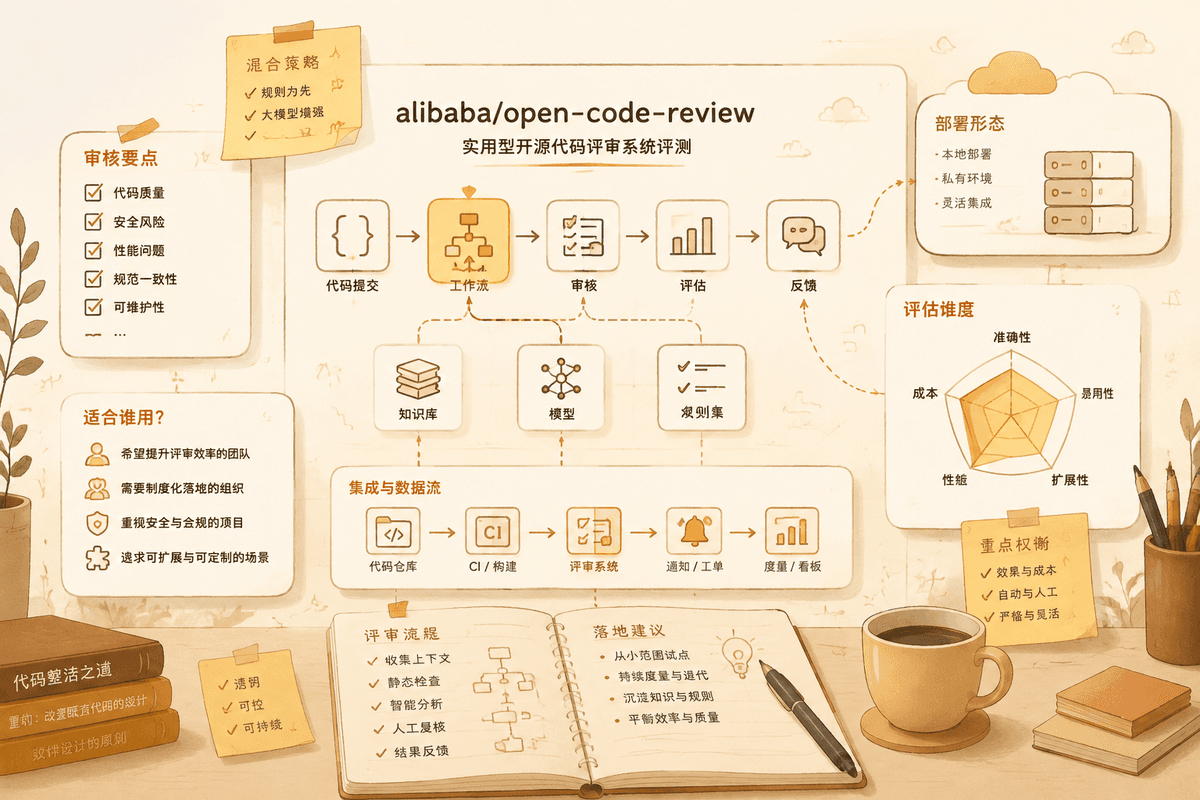
When checked on August 13, 2026, the repository had about 20,366 GitHub stars, 1,435 forks, an Apache-2.0 license, and recent activity. Its description points to a hybrid approach: deterministic pipelines plus an LLM agent, precise line-level comments, and built-in rules for issues such as null pointer errors, thread safety, XSS, and SQL injection.
Why Hybrid Review Matters
Pure LLM review can sound impressive but behave inconsistently. It may produce helpful comments in one pull request and vague advice in another. Traditional static analysis is more deterministic, but it can be noisy or limited to known patterns.
The interesting part of Open Code Review is the hybrid framing. Rules can catch repeatable issues. An LLM can explain context, connect related files, or translate findings into more readable comments. Used together, they may cover more ground than either approach alone.
This is the right direction for real teams. AI review should not replace every human reviewer. It should reduce obvious misses, surface risky lines earlier, and let humans spend more attention on design, product behavior, and subtle trade-offs.
What Users and the Industry Report
Open Code Review originated as Alibaba Group's internal code review assistant. According to the project's documentation, it has served tens of thousands of developers and reviewed millions of code changes internally over two years before being open-sourced.
A Substack review noted that most "AI code review" today is either a SaaS bot commenting on PRs or a general-purpose coding agent asked to review a diff. Open Code Review is different: it is a CLI tool that combines static analysis rules with LLM reasoning, producing line-level comments rather than vague file-level summaries. Early adopters on GitHub report that the precision of line-level comments is its strongest differentiator vs. generic LLM review.
Community feedback patterns:
- The built-in rules for null pointers, thread safety, XSS, and SQL injection catch real issues that generic LLMs miss
- CLI-first design means it integrates into existing CI pipelines without a separate SaaS subscription
- Model flexibility: works with Qwen, GPT-4, Claude, and other providers
- The main complaint is that rule customization documentation is thin ?teams want to add domain-specific rules but find the extension API underdocumented
- False positive rate on style suggestions is higher than on security findings
The strongest signal of real-world usage: Alibaba's internal toolchain uses the same codebase, which means bug fixes and improvements flow from production use rather than community-only development.
AI Code Review Tools Compared
| Tool | Approach | Deployment | Line-Level Comments | Built-in Rules | License |
|---|---|---|---|---|---|
| Alibaba Open Code Review | Hybrid (rules + LLM) | CLI / CI | Yes | Yes (security, style) | Apache-2.0 |
| GitHub Copilot Code Review | LLM-only | GitHub SaaS | Yes | No | Proprietary |
| Graphite AI | LLM + CI context | SaaS | Yes | No | Proprietary |
| SonarQube | Static analysis | Self-hosted | Yes | Yes (1000+ rules) | LGPL / Commercial |
| Semgrep | Pattern matching | CLI / SaaS | Yes | Yes (community rules) | LGPL |
Deployment Difficulty
Git-Stars score: Medium
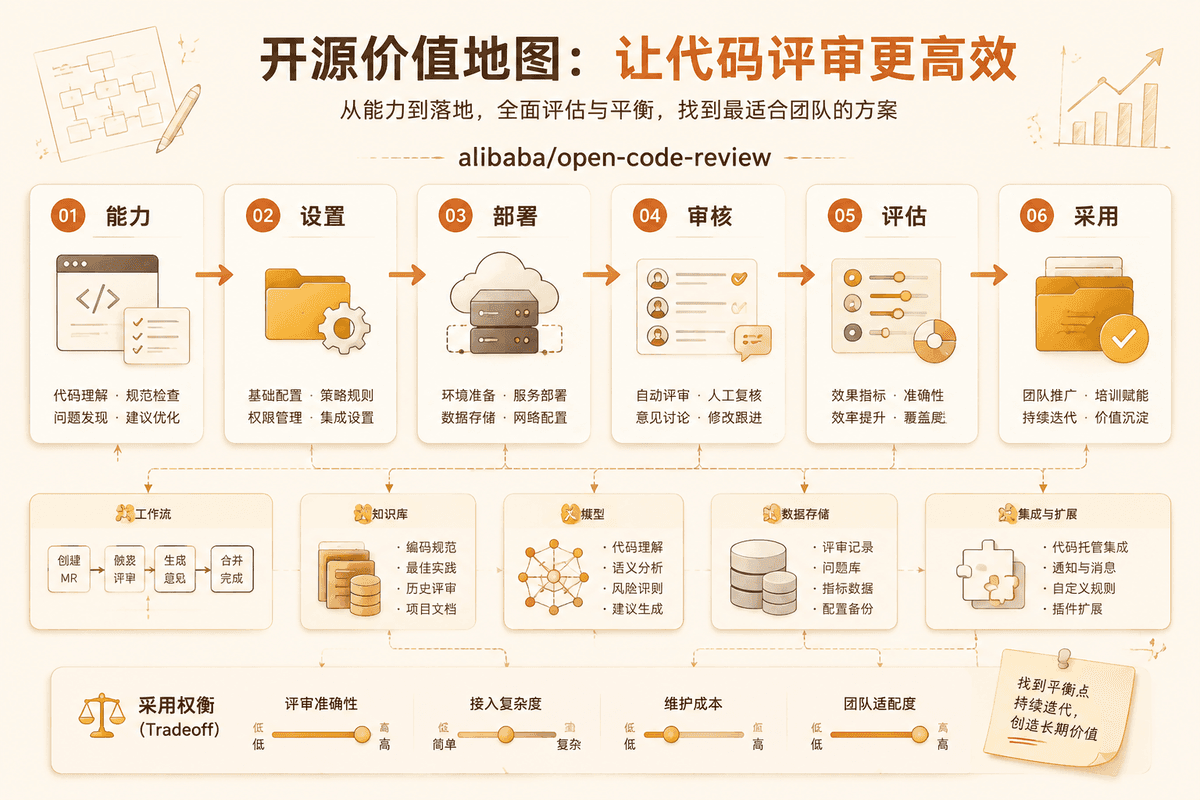
The project is easier to justify than a broad agent platform because its job is clear: review code. But integration still matters. Users need to connect it to repositories, model providers, review workflows, and possibly CI.
For a small team, the safest first test is to run it on a sample repository or older pull requests. Compare its comments with real human review outcomes. Did it find useful issues? Did it produce noise? Did it misunderstand framework patterns? Did it leak sensitive context to an external model?
For larger organizations, deployment requires policy. Which repositories can be scanned? Which models are approved? Are comments advisory or blocking? Who maintains the rule set?
Commercial Usability
Git-Stars score: High
The repository reports an Apache-2.0 license, which is generally friendly for commercial use and includes a patent grant. That is a strong signal for business evaluation.
The main commercial risk is data exposure. Code review tools read source code, diffs, comments, and sometimes issue context. If the tool sends data to an LLM provider, the provider's terms and retention policies matter. If it runs locally or through a private model gateway, the risk profile changes.
Teams should document whether code leaves their network, which model sees it, and whether generated comments are stored. Commercial usability is high only when the review pipeline is auditable.
Capability Ceiling
Git-Stars score: High for routine review, Medium for architecture
AI-assisted review is strongest for repeated patterns: missing validation, risky null handling, suspicious SQL, weak error handling, concurrency mistakes, and inconsistent style. It can also help junior reviewers understand why a line is risky.
It is weaker for product intent, architectural trade-offs, performance under real traffic, or whether a change matches a roadmap. Human review remains necessary.
Compared with Archon, Open Code Review is narrower and easier to reason about. Archon orchestrates coding workflows; Open Code Review focuses on reviewing code. Compared with security tools such as Trivy, it is closer to source-level review than dependency and container scanning.
Who Should Try It
Try Open Code Review if your team has many pull requests, repeated review patterns, or a need for early feedback before human reviewers spend time. It is especially useful if you treat AI comments as suggestions, not authority.
Avoid using it as a merge gate until you have measured false positives, false negatives, and model-data handling. A noisy AI reviewer can reduce trust faster than it improves quality.
For general repository adoption, this fits the process described in our open-source safety checklist: look at license, maintenance, data flow, and where the tool sits in a critical workflow.
Git-Stars Verdict
Open Code Review is a strong topic because it shows where AI can help software teams without pretending to replace judgment. The best code review systems will not be pure chatbots. They will combine rules, context, LLM explanations, and human approval.
That makes this project worth watching. Its value is not "AI reviews code." Its value is whether AI can make human review earlier, calmer, and more consistent.
更多洞察

Why Voice and Audio AI Projects Are Becoming Viral
A practical look at why open-source voice, speech, and audio AI repositories attract attention and how users should evaluate them.

开源 AI Agent 的崛起:趋势与评估
AI 编码代理如何重塑开源格局、评估它们时应关注什么,以及生态系统的发展方向。

Hallmark and Design Skills: Can Open Source Teach AI Better Taste?
A Git-Stars review of Hallmark, emilkowalski/skills, and why reusable design guidance matters for Codex, Claude Code, and AI-built interfaces.
邮件列表
加入我们的社区
订阅邮件列表,及时获取最新消息和更新