
How Git-Stars Defines Useful Open-Source Content
The editorial standard Git-Stars uses to decide whether repository analysis is genuinely useful to readers.
Git-Stars exists because open-source discovery is noisy. A repository can be popular without being suitable. A project can trend without being maintainable. A README can be persuasive without explaining the risks. Useful open-source content should help readers make better decisions, not simply repeat what is already visible on GitHub.
This editorial note explains how we define useful content on Git-Stars. It is also a boundary for our own work: if an article does not add judgment, structure, or practical context, it does not belong here.
Useful Content Answers a Decision
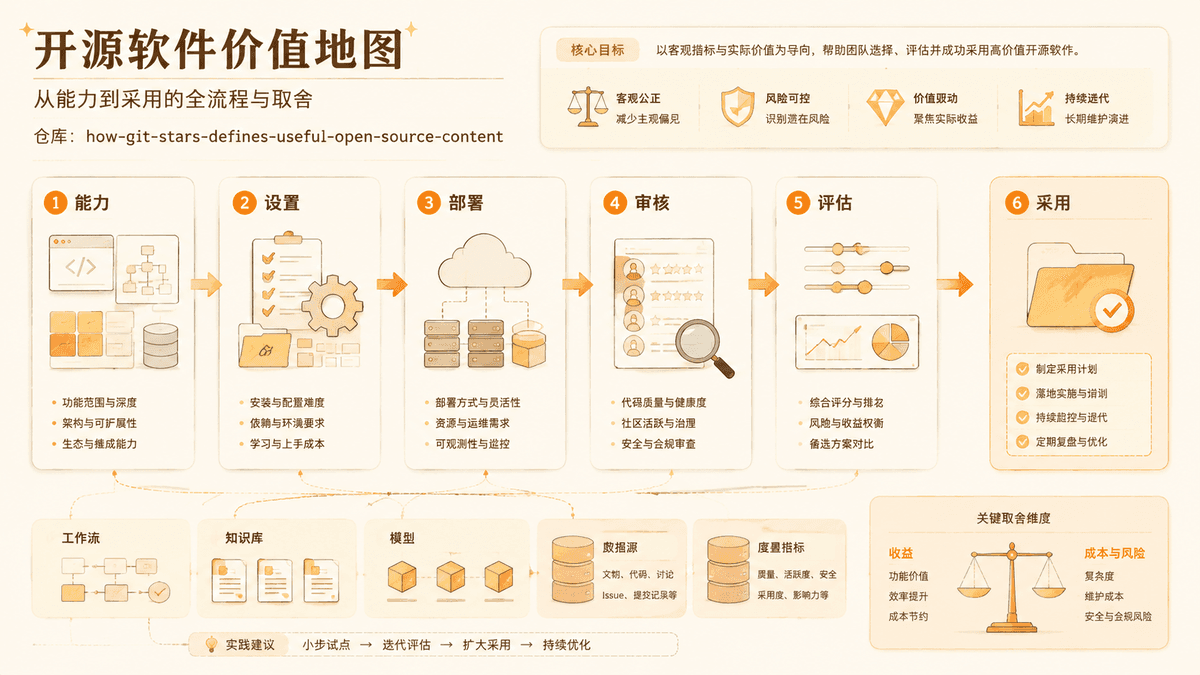
The first test is whether a page helps a reader decide something. A repository summary that says "this is a popular JavaScript framework" is not enough. A useful page should help answer questions such as:
- Should I evaluate this project for my stack?
- Is it suitable for non-coders?
- Can I use it commercially?
- How hard is it to deploy?
- What are the serious alternatives?
- What risks should I check before adopting it?
- Is the project viral because it is useful, novel, or simply well-presented?
This is why Git-Stars separates rankings, trend pages, Insights, and Viral Repos. Rankings help with discovery. Insights explain patterns. Viral Repos turn attention into a practical decision guide.
We Do Not Treat GitHub Stars as Quality
Stars are useful, but they are not a quality score. A star is a lightweight signal of attention, interest, or bookmarking. It does not prove that someone installed the project, used it in production, reviewed the license, or trusted the maintainers.
Git-Stars keeps star counts visible because they matter for discovery. But our editorial content adds other questions: maintenance, documentation, deployment, license clarity, commercial usability, alternatives, and user fit.
This matters because readers often arrive with a shortcut in mind. They want to know whether the most-starred project is the safest choice. Sometimes it is. Sometimes a smaller, focused, actively maintained project is better.
Useful content should slow down bad shortcuts without making evaluation feel impossible.
We Add Context Instead of Mirroring READMEs
GitHub already hosts project descriptions, README files, issues, releases, and source code. Copying those materials would not help readers, and it would create low-value pages. Git-Stars may quote or summarize small pieces when needed, but our goal is not to mirror repository documentation.
Our added value should come from:
- Explaining the problem a project solves
- Identifying who the project is for
- Noting deployment and operational constraints
- Comparing nearby alternatives
- Explaining license and commercial-use concerns
- Highlighting where claims need verification
- Translating technical setup into practical steps
If a page can be replaced by the README, the page is not good enough.
We Prefer Specific Trade-Offs Over Generic Praise
Open-source content often becomes low value because it praises everything. "Fast and powerful" does not help. "Easy to use" does not help unless we explain easy for whom, under which setup, and compared with what.
Useful analysis names trade-offs. A local AI tool may offer privacy but require hardware. A hosted platform may be easier but introduce cost and data-sharing concerns. A framework may be flexible but harder for beginners. A permissive license may be commercially friendly, while a source-available license may need legal review.
This is why Viral Repos uses three axes: deployment difficulty, commercial usability, and capability ceiling. They force the article to discuss practical adoption, not only excitement.
The standard should also work across very different projects. A framework such as Next.js needs discussion of ecosystem fit and upgrade cost. A local AI workflow tool such as ComfyUI needs hardware and model-management context. A compact backend such as PocketBase needs a different conversation about scale, data ownership, and operational limits. If one article structure cannot adapt to those differences, the structure is too generic.
We Write for Both Developers and Serious Non-Coders
Many GitHub projects now attract people who are not professional developers. Creators want voice tools. Founders want automation. Educators want AI workflows. Operators want dashboards. Designers want image tools. These users can benefit from open source, but they need different explanations.
Git-Stars should not pretend every reader can debug a Docker network, read a license like a lawyer, or inspect a Python dependency tree. At the same time, we should not oversimplify technical risk.
Good content bridges that gap. It explains what a project does in plain language, then gives enough technical context for a careful decision.
We Avoid Unsupported Authority Claims
Trust is damaged when a site makes claims it cannot support. We avoid phrases that imply secret scale, private datasets, or unavailable evidence unless the methodology and data are visible. When we make a judgment, it should be tied to observable signals, project documentation, license metadata, issue patterns, or clearly labeled editorial reasoning.
This is especially important when AI assists analysis. AI can help summarize, compare, and draft, but it can also overstate confidence. Our editorial standard requires checking that claims are grounded and that uncertainty is not hidden.
We Treat AI Assistance as Assistance
AI can speed up repository analysis, but it should not replace editorial judgment. A useful AI-assisted article still needs human review for:
- Unsupported claims
- License mistakes
- Confusing setup advice
- Overly broad conclusions
- Missing alternatives
- Safety or privacy risks
- Repetitive structure
Readers do not benefit from generic AI text. They benefit from clear judgment, specific examples, and honest boundaries.
Our Editorial Policy and Methodology pages exist to make that boundary visible.
What Makes a Page Ready to Publish
Before publishing a Git-Stars article, we check against a concrete quality bar:
| Criterion | Minimum Standard | How We Verify |
|---|---|---|
| Original value | Adds analysis, comparison, or decision framework beyond the README | Would a reader learn something they cannot find on the GitHub page? |
| Clear audience | Article states who it is for | First 100 words identify the reader (developers, non-coders, founders, teams) |
| Real examples | Uses specific, named projects | At least 2 real repo names with context, not hypothetical tools |
| Named risks | Does not hide deployment, license, or cost concerns | Each article surfaces at least one trade-off or limitation |
| Internal paths | Connects to related Git-Stars content | At least 1 cross-link to another blog post, ranking, or methodology page |
| Standalone clarity | Works for readers arriving from search | No assumption that the reader knows our product |
| Non-generic structure | Not a template repeated across articles | Each article's sections reflect its specific topic, not a universal formula |
Is there original value? The article must add analysis, comparison, or a decision framework.
Is the reader clear? We should know whether the page is for developers, non-coders, founders, teams, or evaluators.
Are examples real? Project examples should be specific and relevant.
Are risks named? Deployment, license, maintenance, privacy, and cost risks should not be hidden.
Are internal paths useful? The article should connect to rankings, Viral Repos, Insights, or methodology pages where relevant.
Could the page stand alone? A reader arriving from search should understand the topic without needing to know our product first.
This standard is intentionally stricter than "does the page have enough words?" Depth matters, but word count alone is not value.
The Kind of Site We Want to Be
Git-Stars should feel like a patient technical editor sitting between GitHub and the reader. We are not trying to make every repository look exciting. We are trying to make open-source choices clearer.
Sometimes that means recommending a project. Sometimes it means saying a tool is interesting but not ready for a non-coder. Sometimes it means pointing to a hosted alternative, a more mature dependency, or a lower-risk path.
Useful content earns trust by helping readers avoid mistakes as much as by helping them find new tools.
That is the standard we will keep applying as Git-Stars grows.
作者
分类
更多洞察

Why Voice and Audio AI Projects Are Becoming Viral
A practical look at why open-source voice, speech, and audio AI repositories attract attention and how users should evaluate them.

Agent Skills: Why AI Coding Agents Need Reusable Working Memory
A practical review of addyosmani/agent-skills and why reusable skills are becoming an important layer for Codex, Claude Code, and AI coding workflows.
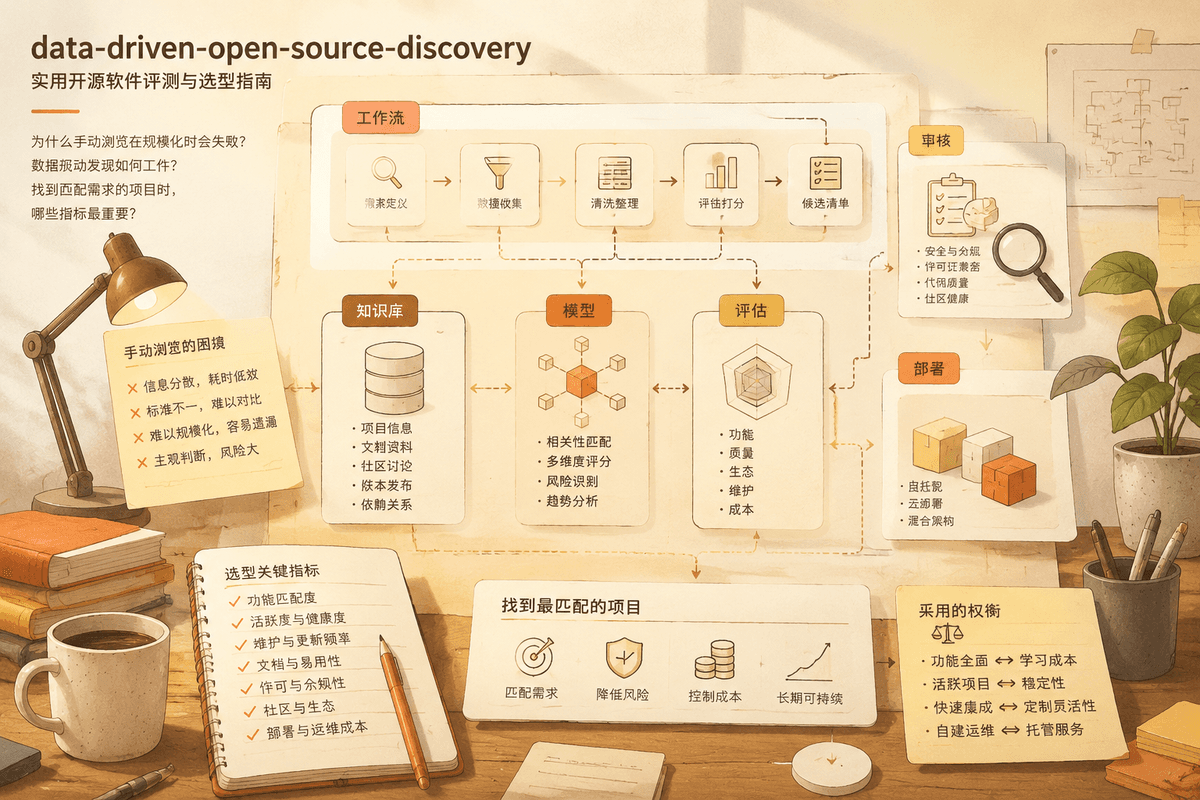
构建数据驱动的开源发现方法
为什么手动浏览 GitHub 在规模化时会失败、数据驱动发现如何工作,以及找到匹配需求的项目时哪些指标最重要。
邮件列表
加入我们的社区
订阅邮件列表,及时获取最新消息和更新